
Enterprise Engineering Series | ECM Practice | Lab 05 of 26
Alfresco
By Ewing R. Samuels III | Samuels Enterprises, LLC
As enterprise content platforms expand across an organization, another engineering problem emerges.
A repository may securely manage millions of documents. Metadata may provide context. Workflow may automate business processes. Governance may control access and lifecycle.
But what happens when the surrounding technology changes?
New applications appear.
New interfaces are required.
Business processes evolve.
Cloud architectures replace older infrastructure.
The content still has to remain accessible, understandable, secure and governed.
The platform cannot become an architectural dead end.
That is where Alfresco becomes useful as the next engineering study.
From Configurable Solutions to Extensible Architecture
Lab 04 examined Hyland OnBase and the need to maintain common enterprise controls while allowing departments to configure processes around their own operations.
Lab 05 extends that idea.
If departments, applications and processes interact with managed information differently, the underlying content platform needs controlled ways for those systems to participate.
The progression becomes:
Repository → Content Model → Services → APIs → Applications → Integrations → Modernization
The repository remains important.
It simply becomes part of a larger architecture.
Content Has Structure
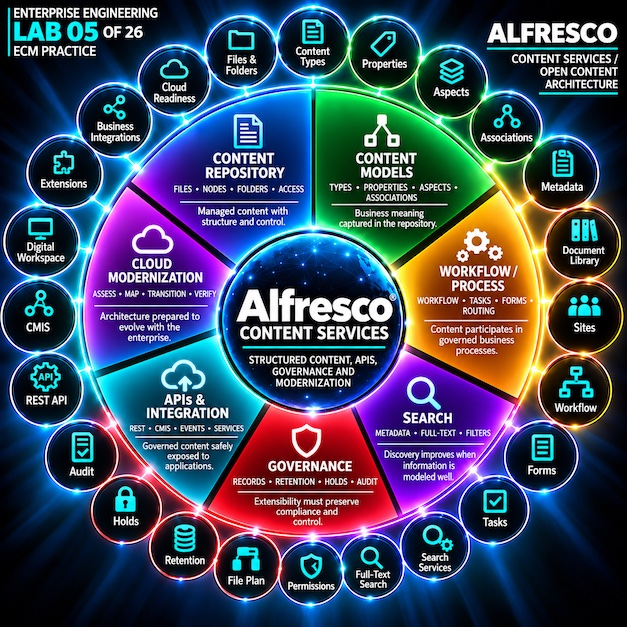
One of Alfresco’s most useful architectural concepts is its content model.
A file can become a repository node.
That node can have a type, properties, reusable aspects and relationships to other objects.
The progression can be understood as:
File → Node → Type → Property → Aspect → Association
This changes how we think about enterprise content.
A contract is not simply contract.pdf.
It can become a business object containing a contract number, customer, effective date, status, jurisdiction and relationships to other information.
The repository becomes significantly more useful when it can represent business meaning and relationships, rather than merely files and folders.
That is information architecture.
Metadata Should Describe the Business
Alfresco provides several mechanisms for describing information:
Content Type defines what something is.
Property captures structured information.
Aspect adds reusable characteristics.
Association describes relationships between repository objects.
Categories and tags support classification and discovery.
The engineering principle is broader than the technology.
Metadata should represent something meaningful about the business.
If the organization must distinguish contracts from invoices, policies from procedures or active records from superseded information, the content model should reflect those distinctions.
Technology becomes more valuable when its information model reflects the organization using it.
Composition Instead of Duplication
Alfresco’s concept of aspects introduces another useful systems principle.
Several different content types may require the same characteristics.
Instead of redesigning each type independently, reusable metadata and behavior can be applied where needed.
The architectural idea is simple:
composition rather than duplication
Good systems architecture identifies what should remain unique and what should be reusable.
Duplication increases maintenance.
Reusable architecture creates consistency.
Content Participates in Process
Workflow remains part of the architecture:
START WORKFLOW → ASSIGN TASK → REVIEW → APPROVE / REJECT → COMPLETE
But by Lab 05, workflow itself is no longer the primary lesson.
We already understand that enterprise content participates in business processes.
The more important question is how repository information, workflow, forms, applications and services interact as components of a larger system.
The content platform is not merely storing the artifact generated by the process.
It participates in the process.
Search Still Begins Before Search
Alfresco reinforces another principle carried through this series:
Retrieval quality is partly determined at ingestion.
Full-text search can locate words inside documents.
Metadata search can locate information according to business attributes.
Filtering can narrow results according to type, state, classification and other structured characteristics.
But none of these eliminate the importance of good information architecture.
If content enters the repository without meaningful classification or metadata, the organization has already limited what it will be able to discover later.
Search is partly a search-engine problem.
It is also a content-modeling problem.
Extensibility Cannot Eliminate Governance
The easier information becomes to consume across applications, the more important controlled access becomes.
Alfresco Governance Services introduces concepts such as file plans, retention schedules, holds, records search, auditing, permissions and security controls.
The full records-management problem comes later in this Enterprise Engineering series.
For now, the lesson is:
Extensibility cannot come at the expense of governance.
An API does not mean every application should receive every document.
An integration does not eliminate retention requirements.
A new interface does not invalidate permissions.
The architecture must preserve control as information moves beyond the repository.
The API Changes the Architectural Conversation
This is where Alfresco adds an important dimension to the ECM story.
REST APIs, CMIS, search interfaces, people and group services, audit capabilities and extension patterns allow the repository to participate in a broader technology environment.
The progression becomes:
Content Repository → Services → API → Application → Enterprise
The important question is not:
Does the platform have an API?
The better question is:
Can enterprise information remain governed while being safely consumed by other applications and services?
That requires authentication, authorization, stable information models, identity, data mapping, auditability and integration logic.
An API creates connectivity.
Architecture determines whether that connectivity is reliable.
Interoperability Is an Enterprise Requirement
Enterprises rarely operate one platform forever.
Systems coexist.
Applications change.
Mergers introduce new repositories.
Legacy environments remain active.
New services still need access to existing information.
Standards such as CMIS demonstrate the architectural value of interoperability by reducing the need for every application to understand every internal detail of every repository.
The distinction is important:
Integration connects systems.
Interoperability makes those connections more sustainable.
From Principle to Practice — Explore Lab 05
The concepts discussed here can be explored through the corresponding Samuels Enterprises Enterprise Engineering Lab.
LAB 05 — ALFRESCO
[ LAB 05 INTERACTIVE EXPERIENCE ]

The article explains the engineering principle.
The Lab demonstrates how that principle appears inside an enterprise system.
Modernization Begins Before Migration
Eventually every long-lived enterprise platform encounters another question:
What happens next?
Infrastructure changes.
Deployment models change.
Interfaces change.
Security requirements evolve.
Alfresco gives us a useful way to introduce modernization without leaving the ECM practice prematurely.
A disciplined sequence can be expressed as:
ASSESS → MAP → PROTECT → TRANSITION → VERIFY
Assess what exists.
Map its dependencies.
Protect the information and controls that must survive.
Transition deliberately.
Verify that the resulting environment still works as intended.
Modernization is therefore much more than moving files.
Repository structures, metadata, permissions, processes, APIs and integrations may all be affected.
Modernization begins with understanding the architecture.
The Platform Must Survive Change
Enterprise content platforms should not be evaluated only by what they store.
We must also understand:
how information is modeled
how services expose it
how other systems integrate with it
how governance survives those integrations
and
how the architecture evolves without losing the information it was designed to protect
That is what distinguishes a repository from an architectural platform.
Technology will change.
Applications will change.
Business processes will change.
The information may need to survive all of them.
What Alfresco Adds to the ECM Story
Our ECM progression continues to expand.
Documentum introduced the idea that the document is not the system.
OpenText demonstrated that the repository is not the enterprise.
FileNet pushed the discussion toward objects, identity, state, events and process.
OnBase demonstrated how common enterprise controls can support different departmental operating models.
Alfresco adds another dimension:
the content platform itself must remain capable of participating in an evolving technology architecture.
Content must remain structured.
Applications must be able to consume it.
Integrations must preserve control.
Modernization must occur without sacrificing meaning, relationships or governance.
That is extensible content architecture.
From Extensible Content to Intelligent Process
But extensibility introduces another engineering question.
Once content is structured, searchable, governed and available through services and APIs, how much of the work surrounding that content can the enterprise automate?
Can information enter through intelligent forms?
Can business rules determine where it goes?
Can workflows respond automatically?
Can records requirements participate directly in those processes?
That moves us from extensible content architecture toward documents, forms, workflow and automation operating as one coordinated information system.
NEXT — ENTERPRISE ENGINEERING LAB 06
ECM – Laserfiche
Alfresco asks how enterprise content remains open enough to evolve.
Next, we examine what happens when governed information becomes increasingly connected to forms, workflow, records and business-process automation.
Enterprise Engineering Series
Ewing R. Samuels III
Samuels Enterprises, LLC
Lab 05 of the 26-Lab Enterprise Engineering Series