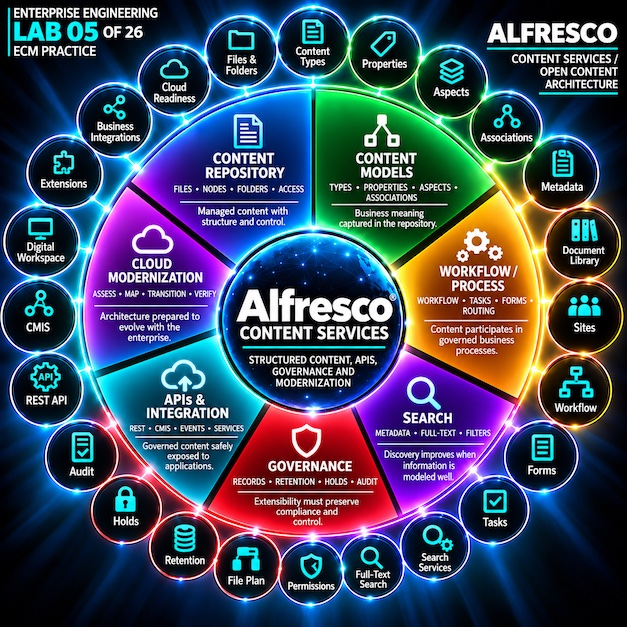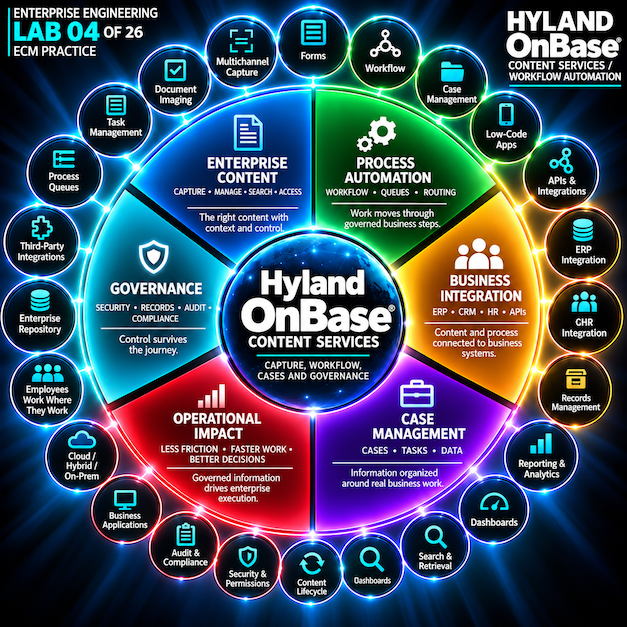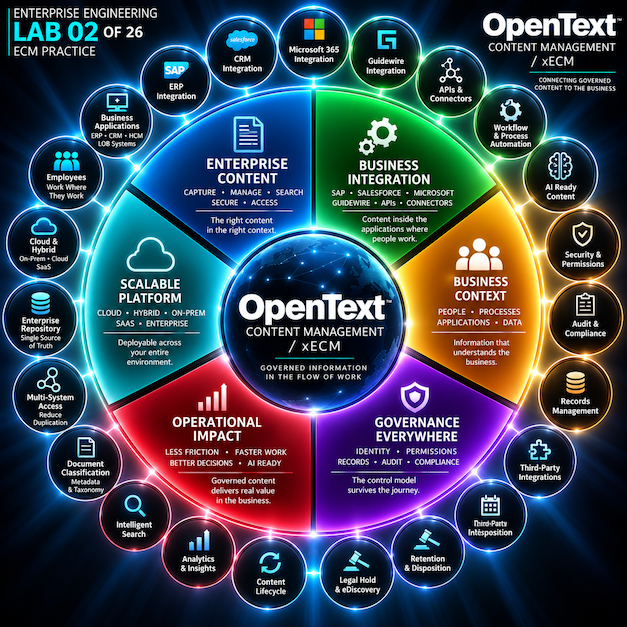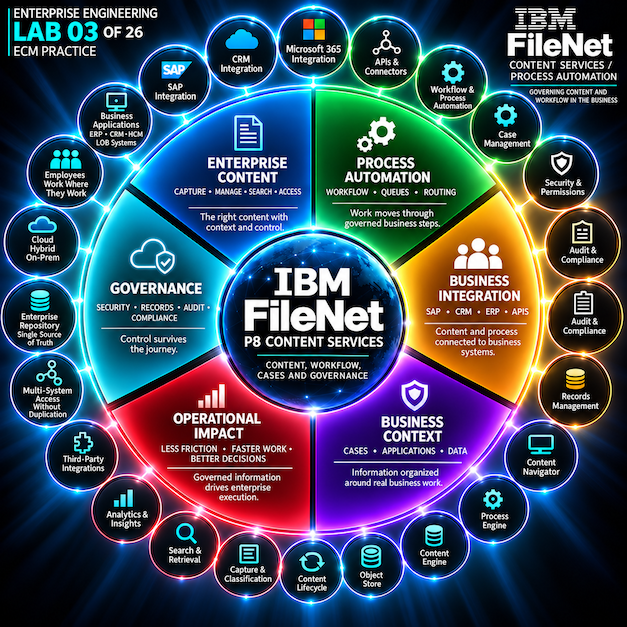

Enterprise Engineering Series | ECM Practice | Lab 03 of 26
IBM FileNet
By Ewing R. Samuels III | Samuels Enterprises, LLC
Enterprise information rarely enters a system merely to sit there.
A contract arrives because someone must review it.
A claim is created because someone must investigate it.
An invoice is received because someone must approve and pay it.
By Lab 03, the engineering problem has evolved.
In Lab 01, EMC / OpenText Documentum established:
The document is not the system.
In Lab 02, OpenText Content Management / xECM extended that thinking:
The repository is not the enterprise.
Governed information has to reach the business applications and processes where people actually work.
Now the next question appears:
Once the right information is available in the right context, what happens to it next?
IBM FileNet helps expose that next layer.
Because enterprise information does not simply have content.
It has state.
Information Exists Inside a Process
A document may move through:
received → classified → assigned → reviewed → approved → completed → retained
Those words describe more than storage.
They describe the condition of the business.
A contract in negotiation is different from an executed contract.
A claim under review is different from a claim approved for payment.
The document may be the same file throughout the process, but its business meaning changes as its state changes.
Knowing what something is does not always tell us what should happen to it next.
Metadata identifies information.
Process determines what the organization does with it.
Content Becomes a Business Object
FileNet demonstrates an important architectural shift:
A document can be treated as more than a file.
It can become a business object with properties, relationships, security and state.
Instead of seeing only:
claim_004872.pdf
the enterprise can understand:
Type: Insurance Claim
Claim Number: 004872
Status: Under Review
Assigned To: Claims Department
Process Stage: Documentation Review
The file is only one part of the system.
Its metadata and relationships tell the enterprise what it represents.
That is why object-oriented content architecture is more powerful than simply building folders.
A folder tells people where something is.
An object model tells the enterprise what that thing is.
Workflow Gives Content Direction
Once information is understood as a business object, workflow becomes meaningful.
A contract may require one approval path below a certain value and another above it.
A claim may require escalation when documentation is missing.
An invoice may move automatically to another queue when a threshold is exceeded.
The content itself may not change.
The business response to it does.
That is process engineering.
And production workflow is much more than drawing boxes and arrows.
The system must answer:
Who owns the next action?
Who may see the information?
What happens when someone does nothing?
What happens when approval fails?
What happens when a system performs the next step instead of a person?
A business process is controlled movement through business state.
Events Make Information Active
Enterprise systems become more powerful when they can respond to events.
A document arrives.
A property changes.
A new version appears.
A deadline is reached.
A status becomes approved.
Instead of waiting for a person to remember what happens next, the system can react.
The pattern changes from:
User remembers → user searches → user acts
to:
Event occurs → condition recognized → process begins → work is routed → state is recorded
The system begins carrying part of the organization’s operational memory.
Automation begins when a system can recognize that something happened and understand what should happen next.
Security Must Follow the Process
When information starts moving through workflows, security becomes more complex.
The question is no longer only:
Can this person open this document?
It becomes:
Can this person perform this action at this stage of the process?
One employee may create information.
Another may review it.
A supervisor may approve it.
An auditor may see the history without being able to alter it.
This is where identity, security and workflow become interconnected.
Identity tells us who is acting.
Security determines what they may do.
Workflow determines when the action is appropriate.
State tells us where the business currently stands.
Good enterprise architecture connects all four.
Which State Is True?
Workflow introduces another critical problem:
Which system contains the authoritative state?
Suppose one application says a claim is approved while another still says it is under review.
Suppose a copied spreadsheet contains an older status.
Suppose an email says approval occurred, but the workflow history contains no evidence of it.
Now the enterprise has competing versions of reality.
Good systems therefore require clearly defined authoritative sources and controlled transitions between states.
They must also account for the fact that processes themselves change.
Policies change.
Approval thresholds change.
Departments reorganize.
Regulations evolve.
The enterprise must therefore understand both:
what the process is today
and
what process governed a transaction when it occurred.
That is the difference between simply automating work and preserving operational integrity.
Search Gains Business Meaning
Once content has structure and state, search becomes more useful.
Instead of searching only for:
“service agreement”
the organization can search for:
contracts awaiting approval
claims assigned to a department
transactions at a particular process stage
documents associated with a customer
Search is no longer concerned only with words inside files.
It begins answering operational questions.
This extends a principle established earlier in the series:
Retrieval quality is partly determined at ingestion.
Lab 03 adds another dimension:
Retrieval quality also depends on how well the enterprise models business state.
Integration Becomes Process Integration
Lab 02 explored how governed content must appear inside the business environment.
Lab 03 takes that idea further.
Once information participates in workflow, integrations must exchange more than files.
Systems may need to exchange:
metadata → status → events → decisions → security context → completion signals
A customer system may initiate work.
FileNet may govern the associated content.
Another service may validate the information.
A financial system may complete a transaction.
The resulting state must then travel back through the environment.
Now we are not simply integrating repositories.
We are coordinating systems around a business process.
A system becomes part of the enterprise when the systems around it can understand its state.
From Principle to Practice — Explore Lab 03
The concepts discussed here can be explored through the corresponding Samuels Enterprises Enterprise Engineering Lab.
LAB 03 — IBM FileNet
[ LAB 03 INTERACTIVE EXPERIENCE ]

The article explains the engineering principle.
The Lab demonstrates how that principle appears inside an enterprise platform.
Why This Still Matters
Technology changes.
Interfaces change.
Infrastructure changes.
But the engineering questions remain:
What information are we managing?
What does it represent?
Who controls it?
What state is it in?
What happened?
What should happen next?
Who owns the next action?
What evidence remains afterward?
Modern automation and artificial intelligence do not eliminate these questions.
They make answering them correctly even more important.
An intelligent system cannot reliably automate an approval process if the organization cannot define what approved means.
It cannot safely act when identity, permissions, state and business rules remain ambiguous.
The architecture is becoming clearer:
Content → Metadata → Object → Identity → Security → Event → State → Process → Action → Evidence
The Engineering Takeaway
IBM FileNet demonstrates that enterprise information is not merely stored.
It can represent a transaction.
It can initiate an event.
It can move through a workflow.
Its metadata can determine routing.
Its state can determine what happens next.
Its history can explain what the organization did and why.
The larger lesson is:
Enterprise information becomes operational when the system understands both what it is and what should happen to it next.
The document has a state.
And state creates responsibility.
The Next Engineering Problem
But once content, workflow, capture and business processes spread across departments, another problem appears.
Different teams receive information differently.
Different processes begin through different channels.
Different applications participate at different points.
The question now becomes:
How do we bring capture, content, workflow and business-process integration together across everyday departmental operations without forcing the enterprise into one rigid way of working?
That takes us directly into:
Enterprise Engineering — ECM Practice — Lab 04 of 26
Hyland OnBase.