
Enterprise Engineering Series | ECM Practice | Lab 02 of 26
OpenText Content Management / xECM
By Ewing R. Samuels III | Samuels Enterprises, LLC
In Lab 01, The Document Is Not the System, I explored a foundational principle of Enterprise Content Management: storing a document is only one part of managing enterprise information.
Once an organization brings structure, security and governance to its information, another engineering problem appears:
How do you get that governed information to people inside the systems where they are already working?
The repository may manage the information.
But the repository is not the enterprise.
When the Repository Becomes Another Destination
Employees rarely spend their entire day inside a content repository.
Finance may operate primarily inside an ERP system. Sales may live inside a CRM. Human Resources may use an HCM platform. Other employees may work primarily through Microsoft 365, Teams or specialized business applications.
Yet the information they need may be governed somewhere else.
That creates friction.
The employee leaves the business application, searches another system, determines which information is correct and returns to the original process.
Multiply that behavior across thousands of employees and millions of interactions.
A small usability problem becomes an enterprise architecture problem.
Centralizing information does not automatically make information available where work happens.
Content Needs Business Context
Imagine a customer record inside a CRM.
That customer may have contracts, proposals, invoices, correspondence, service records and signed agreements.
The CRM understands the customer.
The content-management system understands the documents.
The architecture must understand the relationship between them.
That relationship is context.
Instead of forcing an employee to search another repository, an integrated architecture can make the appropriate governed content available from within the customer’s working environment.
The same principle applies to an employee, supplier, project, property, asset, claim or transaction.
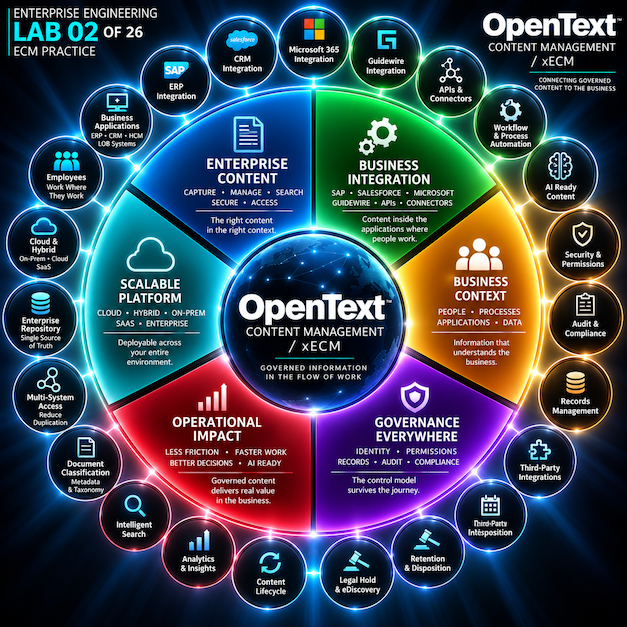
This is one of the architectural ideas represented by OpenText Content Management / xECM: connecting governed enterprise content with the applications and processes where business activity actually occurs.
The important lesson extends beyond the product.
Content becomes more useful when the system understands what the content belongs to.
Metadata Becomes the Bridge
Metadata is often described as information about a document:
Document Type → Author → Created Date → Department
Enterprise metadata can do considerably more.
It can establish relationships:
Customer → Contract → Project → Transaction → Asset → Case → Business Process
A contract is no longer simply a PDF stored somewhere.
It becomes information associated with a customer, governed by a process, protected by permissions and connected to business activity.
The repository knows the content.
The business application knows the transaction.
Integration connects the two.
This is where metadata stops being merely descriptive and becomes architectural.
Access Without Creating More Versions of Truth
A single piece of information may be relevant to Sales, Finance, Legal, Operations and Customer Service.
The easy solution is often to create copies.
Someone downloads the document. Someone emails it. Another copy enters a departmental folder. Another is uploaded into another application.
Eventually several documents appear authoritative.
Now the problem is no longer finding the information.
It is determining which version represents the truth.
A better architectural question is:
How can multiple business environments interact with governed information without destroying its authority?
Where appropriate, enterprise architecture should preserve an authoritative information source while allowing other systems to interact with it according to business context.
Integration should increase access without multiplying versions of truth.
Governance Must Travel With the Information
Integration cannot mean abandoning control.
If content becomes accessible through another application, identity, permissions, records policies and auditability still matter.
The architecture must understand:
Who is requesting the information?
What business context are they operating within?
What are they permitted to see or change?
What actions must be recorded?
That is why enterprise integration is more than displaying a document inside another interface.
The governance model has to survive the journey.
The application may change.
The interface may change.
The obligation to govern the information does not.
The Repository Becomes an Enterprise Service
This represents an important evolution in Enterprise Content Management.
The repository remains essential because it provides the controlled foundation.
But its value increases when those capabilities participate in the larger enterprise:
People → Business Application → Business Process → Content → Repository → Metadata → Identity → Security → Integration → Governance
The technologies can change.
The architectural problem remains.
People need information to complete work.
Business applications provide operational context.
Repositories provide controlled information.
Integration connects those environments.
Governance protects the result.
The employee should not need to understand this architecture.
The architecture should understand enough about the employee’s context to deliver the right information.
From Principle to Practice — Explore Lab 02
The corresponding Samuels Enterprises Engineering Lab demonstrates how governed enterprise content can connect to applications, processes and business context while preserving the architectural controls behind it.
LAB 02 — OpenText Content Management / xECM
[ LAB 02 INTERACTIVE EXPERIENCE ]

The Lab is not intended simply to reproduce a product interface. It demonstrates the relationships between content, metadata, business context, integration, security and governance that allow enterprise systems to operate as parts of a larger whole.
Why This Still Matters
Platforms have changed. Cloud architectures have expanded. APIs are more capable. Automation and artificial intelligence are increasingly embedded into enterprise environments.
But the underlying information problem remains.
Before any system can intelligently use enterprise information, the organization still has to understand:
What is this information?
What does it relate to?
Which version is authoritative?
Who is permitted to use it?
What business process does it belong to?
These are not fundamentally AI questions.
They are information architecture questions.
And they existed long before today’s AI systems.
The Engineering Takeaway
Lab 01 established:
The document is not the system.
Lab 02 extends that principle:
The repository is not the enterprise.
Enterprise architecture cannot stop at centralizing information.
It must connect information to context.
Govern information centrally where appropriate. Deliver it contextually where it is needed.
But once content begins participating in business processes, another engineering problem appears.
Some business activities evolve over time. They accumulate documents, correspondence, decisions, participants, tasks and changing states around a particular matter.
At that point, accessing content is no longer enough.
The enterprise needs to understand the case.
How do we architect information, workflow and business state around a case that evolves over time?
That takes us to IBM FileNet — Lab 03.