
Enterprise Engineering Series | ECM Practice | Lab 04 of 26
Hyland OnBase
By Ewing R. Samuels III | Samuels Enterprises, LLC
Enterprise content management becomes more difficult as it becomes more useful.
Once an organization can securely capture content, describe it with metadata, control access and move information through workflow, the next challenge is no longer whether the technology works.
The challenge becomes:
How do we apply those capabilities across many different business processes without forcing every department to operate exactly the same way?
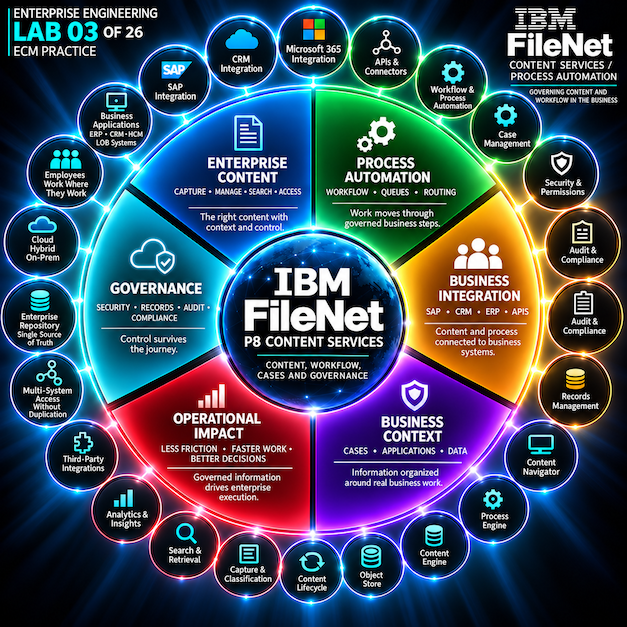
That question follows naturally from IBM FileNet. FileNet showed how enterprise information could become operational through objects, events, state, workflow and process. The progression moved beyond simply storing information toward understanding what the information represents and what should happen to it next. Pasted markdown
Hyland OnBase provides another useful engineering perspective on that problem.
From Enterprise Process to Configurable Solutions
A large organization rarely operates as one process.
Finance may process invoices and purchase requests. Human Resources handles employee records and approvals. Legal manages contracts and cases. Healthcare organizations work with patient information. Universities manage admissions, student records and financial aid.
Each area may require content management, but the surrounding processes, forms, rules, exceptions and integrations can be very different.
That creates an important architectural distinction:
Enterprise standardization does not require every business process to be identical.
The platform can provide common services—security, content management, auditability, retention, workflow and integration—while allowing individual business solutions to reflect the work they actually support.
This is one of the useful engineering ideas exposed by OnBase.
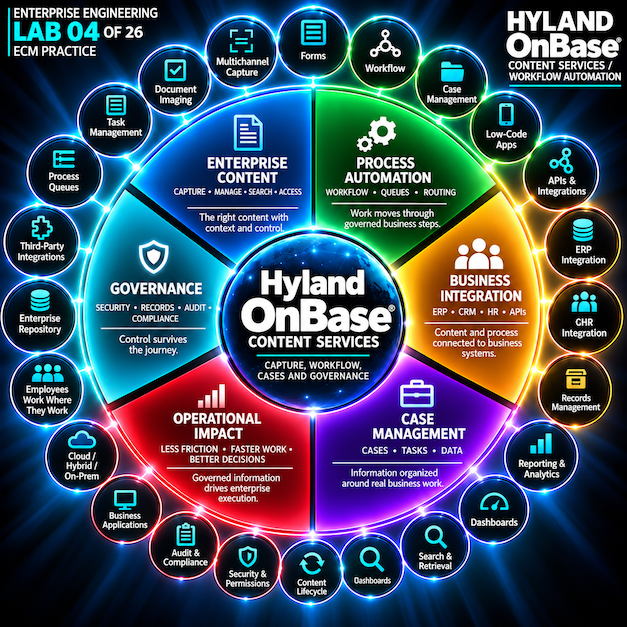
Hyland currently describes OnBase as an operational content management product combining multichannel capture, process automation, case management, collaboration, records management, reporting and integrations with other enterprise systems. Hyland Software, Inc.
The important lesson is not the feature list.
It is what happens when those capabilities are treated as reusable enterprise building blocks.
Capture Is the Beginning of the Process
Enterprise information can arrive through scanned documents, electronic files, forms, emails and other applications.
Capturing it is only the first step.
The system must determine what arrived, associate the correct information with it and make it available to the appropriate process.
OnBase supports multichannel capture and data extraction, allowing captured information to be organized and passed to relevant systems. Hyland Software, Inc.
Architecturally, this creates a chain:
Capture → Classification → Metadata → Business Context → Process
The earlier the system understands the information entering it, the more intelligently everything downstream can behave.
A poorly identified document creates work.
A correctly classified business object can initiate work.
Workflow Must Handle Rules and Exceptions
FileNet established the importance of state and process.
OnBase reinforces another reality: business processes rarely remain perfectly linear.
Some work can be automated. Some requires approval. Some must be escalated. Some arrives incomplete. Some violates a business rule and becomes an exception.
Hyland’s Workflow documentation describes configurable rules and actions for controlled document routing, while still allowing authorized users to accommodate exceptions. Hyland Documentation
That distinction matters.
A useful enterprise workflow does not merely automate the happy path.
It must also help the organization manage everything that does not follow the happy path.
So workflow becomes more than routing:
Input → Rule → Decision → Action → Exception → Resolution → Evidence
The process itself becomes part of the organization’s information architecture.
Structured Processes Are Not Enough
Not every unit of work can be represented by a predictable sequence of steps.
An investigation, complaint, service request, employee matter or customer issue may evolve as new information appears.
That requires a different model.
Instead of asking only:
Where should this document go next?
the system may need to ask:
What information, people, tasks, decisions and history belong to this case?
OnBase supports case-oriented work by bringing related data, documents, tasks, processes and collaboration into a common business context. Hyland Software, Inc.
This expands the ECM model:
Document → Process → Case → Business Context
The unit being managed is no longer necessarily the document.
Sometimes it is the work itself.
Filling the Gaps Between Enterprise Systems
Organizations also accumulate smaller applications around their major platforms.
A spreadsheet tracks one process.
A departmental database handles another.
An email chain becomes an approval system.
A custom application survives because nothing else quite handles the requirement.
Individually, these solutions may seem reasonable. Collectively, they create fragmentation.
OnBase introduces low-code configuration into this problem. Hyland positions the platform as capable of configuring forms, workflows, case-oriented solutions and lightweight business applications while reducing dependence on disconnected point solutions and extensive custom code. Hyland Software, Inc.
This reveals a broader engineering principle:
Sometimes the architectural problem is not the absence of a major enterprise system. It is the unmanaged space between major enterprise systems.
Those spaces are where manual work, duplicate data entry and departmental workarounds frequently develop.
Integration Without Moving the User
Another recurring ECM mistake is assuming that users should constantly leave their primary business application to find supporting information somewhere else.
That creates friction.
If an employee is working inside an ERP, CRM, HR, financial or industry-specific application, the content supporting that transaction should ideally be accessible within that context.
OnBase provides purpose-built, screen-level and data-level integration approaches. Hyland also documents its Enterprise Integration Server as supporting automated data exchange between OnBase and line-of-business applications. Hyland Software, Inc.
The engineering objective is therefore not:
make everyone work in the ECM system.
It is:
make governed information available wherever the work occurs.
That idea will continue to matter throughout enterprise engineering.
From Principle to Practice — Explore Lab 04
The concepts discussed here can be explored through the corresponding Samuels Enterprises Enterprise Engineering Lab.
LAB 04 — HYLAND ONBASE

The article explains the engineering principle.
The Lab demonstrates how that principle appears inside an enterprise system.
The Systems-Thinking Lesson
By this point in the ECM progression, the architecture has expanded considerably.
Documentum introduced the relationship between content, metadata, security, process and governance.
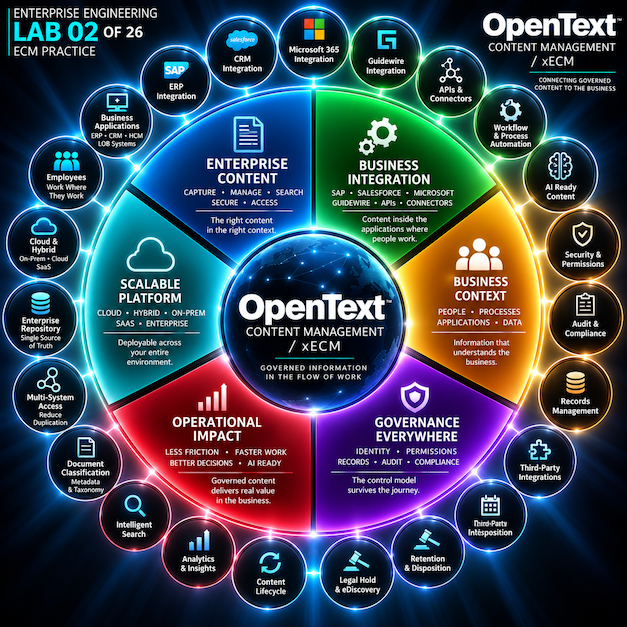
OpenText expanded the discussion into business context.
FileNet demonstrated that information has state and can participate directly in business process.
OnBase adds another dimension:
Capture → Content → Workflow → Case → Application → Integration → Department → Enterprise
The enterprise does not need hundreds of disconnected solutions.
But neither should architecture assume that hundreds of different business problems can be forced into one identical process.
The better objective is a common governed foundation with configurable business behavior above it.
Why This Still Matters
The terminology continues to change.
ECM became content services. Low-code platforms expanded. Cloud architectures matured. Automation and AI increasingly participate in information processing.
But organizations still face the same fundamental problem:
different people perform different work using information distributed across different systems.
Modern architecture still has to connect that information without destroying the business context that gives it meaning.
That is why the engineering lessons behind platforms such as OnBase remain relevant even as the technology surrounding them evolves.
Engineering Takeaway
Enterprise architecture must balance two forces:
standardization and flexibility.
Standardize the capabilities that should be common—identity, security, governance, integration, auditability and information control.
Configure the processes that legitimately need to be different.
That balance allows enterprise systems to scale without requiring the enterprise itself to become rigid.
But once content, workflows, forms and departmental applications begin spreading across the organization, another problem becomes unavoidable:
How long must enterprise information be retained, what constitutes an official record, and how does the organization prove that information was governed correctly throughout its lifecycle?
That moves the Enterprise Engineering series toward the next architectural layer.
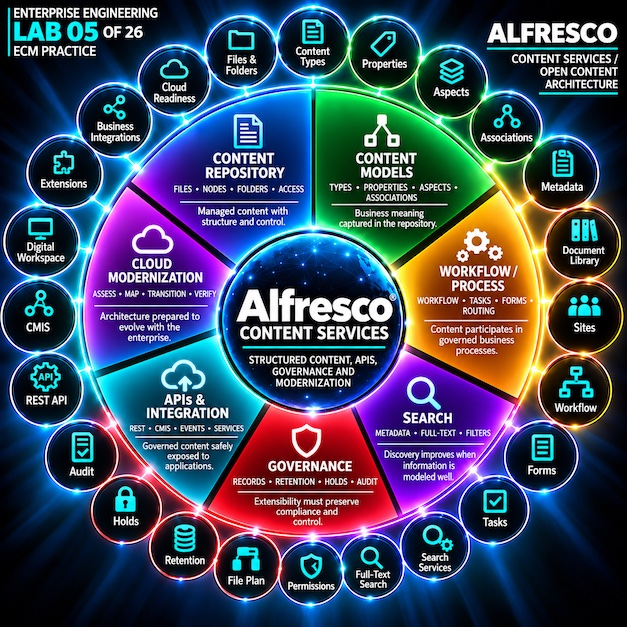
Enterprise Engineering — ECM Practice — Lab 05 of 26
Records Management