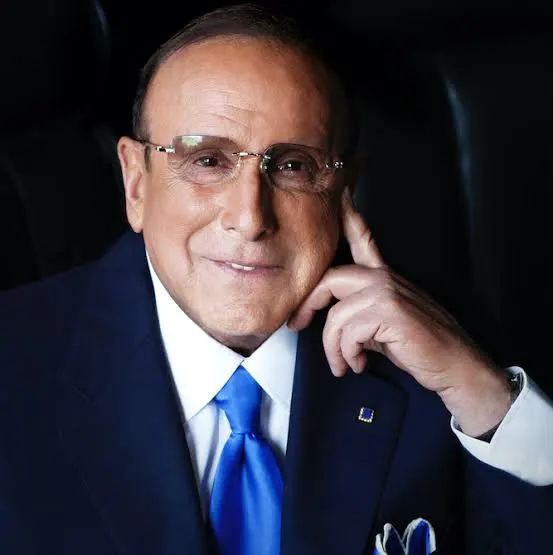

The passing of Clive Davis caused me to think about a brief conversation I had with him more than twenty-five years ago.
It was not a long meeting.
There were no contracts signed, no major announcement and no photograph designed for publicity.
It was simply a few words from a man who had already been shaping the music business before I was born.
Yet those words never left me.
An Earlier Connection
The story actually begins three years before I met him.

In 1998, my uncle Steve Taylor met Clive Davis’ daughter, Lauren B. Davis, who was working as an attorney in New York with connections to music publishing and the entertainment business.
My uncle obtained her business card and wrote on the back:
“Clive Davis daughter — music publishing.”
I still have that original card today.


It is a small but meaningful piece of history. It shows that the connection to the Davis family and the professional music world did not begin with a story reconstructed decades later. There is physical evidence from 1998 that remains in my possession.
At that time, however, I was going through one of the darkest periods of my young life.
The death of my cousin in 1998 and my mother in 2000 had severely affected me, and I was dealing with depression. Although opportunities and connections were forming around me, I was not emotionally prepared to pursue everything that may have been available.
That is an important truth about life.
Opportunity does not always arrive when we are ready for it.
Sometimes the door appears while we are still trying to survive what happened in the room behind us.
Working at Interscope Records
By late 2000, I had begun moving forward again.
At the time, I was working for Interscope Records. I was already inside a professional major-label environment, observing the music business from within while continuing to develop as a songwriter, producer and entrepreneur.

I had also established my own independent record label and publishing company at eighteen years old, so I was not entering the industry without preparation. I was young, but I had already committed myself to learning both the art and the business of music.
During that period, I attended Clive Davis’ celebrated pre-Grammy Awards party at the Beverly Hills Hilton Hotel in February 2001. I will never forget this date because it was the one year anniversary of my own mother’s passing.
That was where I met him.
“That’s It”
Our conversation was brief, but Clive Davis had a way of reducing complicated ideas to something direct and memorable.
He said to me:
“Ewing, music should be simple, soulful and sincere. That’s it.”
Those words struck the core of what I already understood.
Music does not become powerful merely because it is complicated.
A production can be technically advanced. An arrangement can contain numerous instruments, harmonies and changes. A recording can involve the best equipment and the most expensive studio in the world.
But if it does not communicate feeling, none of that matters.
The music must reach people.
It must say something clearly.
It must carry a soul.
Simple.
Soulful.
Sincere.
That philosophy has remained with me throughout my career. It has followed me through different genres, technologies, studios, business environments and stages of life.
The tools have changed dramatically since 2000.
The principle has not.
Who You Know That Likes You
Clive also said something else that I have never forgotten.
People often repeat that the entertainment business is about “who you know.”
He corrected that idea.
He told me:
“This business is not about who you know. It is about who you know that likes you.”
That distinction is much deeper than it may first appear.
A person can know hundreds of executives, artists, attorneys and producers and still have no meaningful relationships with any of them.
Knowing someone’s name is not the same as having their respect.
Possessing a telephone number is not the same as having someone’s trust.
Taking a photograph with an important person is not the same as that person believing in your talent, judgment or character.
Access alone is temporary.
Real relationships are built on trust, respect, reliability and genuine appreciation.
Clive understood the human mechanics behind the music business. Talent matters, but so does how people experience working with you. The industry may be built around songs and recordings, but people still decide who receives opportunities, who is trusted with responsibility and who is welcomed back into the room.
It is not merely who you know.
It is who knows you, respects you and genuinely likes dealing with you.
Young, but Aware
I was young when Clive Davis spoke those words to me, but I was aware enough to understand their value.
Because I was working at Interscope Records at the time, I could immediately connect his words to what I was already seeing inside the industry.

Being near powerful people did not automatically make someone powerful.
Entering an important room did not guarantee that a person belonged there.
What mattered was whether the person possessed the talent, preparation, discipline and character to contribute something meaningful.
Clive’s words confirmed that music and relationships operate according to the same fundamental rule:
They must be real.
The song must be sincere.
The relationship must be sincere.
Anything constructed entirely from appearance eventually reveals its weakness.
Across his extraordinary career, Clive Davis discovered, signed, developed or helped revitalize an exceptional roster of artists, including Janis Joplin and Big Brother and the Holding Company, Bruce Springsteen, Billy Joel, Aerosmith, Santana, Chicago, Earth, Wind & Fire, Barry Manilow, Patti Smith, Whitney Houston, Kenny G, Sarah McLachlan and Alicia Keys. He also played an important role in later chapters of the careers of established legends such as Aretha Franklin, Dionne Warwick and Carlos Santana, while the labels and partnerships he guided were connected to stars including The Notorious B.I.G., Toni Braxton, TLC, Usher, Pink and Outkast. Few record executives helped introduce, develop or renew the careers of so many major artists across so many different genres and generations.
A Career Before My Lifetime
Clive Davis had already established himself in the music business long before I was born in 1978.
By the time I met him in 2001, he had spent decades working with major artists, identifying talent and helping shape the direction of popular music. His career crossed eras, formats, genres and generations.
He witnessed the industry move from vinyl to cassette, from cassette to compact disc, and eventually toward digital distribution and streaming.
Few people remain relevant across so many periods of change.
That longevity itself deserves respect.
Whether one agrees with every decision made over such a long career is not the point of this reflection. The point is that Clive Davis dedicated most of his adult life to music and continued contributing to the industry into his nineties.
He was doing this work before I entered the world.
I was fortunate enough to meet him while I was still a young man finding my own position within it.
The Words Traveled With Me
I could not have known in 2001 how far those words would travel with me.
They traveled through the years I spent producing and writing music.
They traveled through my work in business and technology.
They traveled through personal victories and devastating losses.
They traveled through circumstances that removed me from the professional environments I once knew.
They traveled with me back home to Belize.
And they remain present in the work I create today.
That is the power of sincere advice.
Sometimes a person says only a few sentences, but those sentences become part of how another person thinks for the rest of his life.
Clive Davis gave me two principles that day:
Make the music simple, soulful and sincere.
Build relationships with people who genuinely respect and appreciate you.
More than a quarter of a century later, I understand those lessons even more deeply than I did when I first heard them.
A Personal Salute
This is not a story intended to inflate my own importance.
It is a personal salute to someone who had been contributing to the music business since long before I was born and who took a brief moment to speak directly to a young man working at Interscope Records.
He did not need to give me a long lecture.
He gave me the essence.
I remembered it.
I applied it.
And I carried it with me.
Rest in peace, Clive Davis.
The industry will remember the artists, companies and records connected to your name.
I will also remember a short conversation at the Beverly Hills Hilton Hotel in 2001—and two simple truths that never became outdated:
Music should be simple, soulful and sincere.
And success is not merely about who you know.
It is about who you know that likes you.
That’s it.
Until Next Time…
I Am,
Ewing R. Samuels III