
Enterprise Engineering Series | Records Practice | Lab 14 of 26 OpenText Content Manager / TRIM By Ewing R. Samuels III | Samuels Enterprises, LLC
Enterprise records management is not simply about storing documents. It is about establishing control over business information, including its identity, classification, ownership, retention, security and eventual disposition.
In Lab 13, we examined IBM Content Manager OnDemand and the engineering principles behind high-volume enterprise report archiving and retrieval. Lab 14 advances into a different responsibility: managing information as governed records throughout its lifecycle.
OpenText Content Manager, historically known as TRIM and HP TRIM, provides a framework for managing electronic and physical records under organizational policies, regulatory obligations and documented governance procedures.
The central engineering challenge is straightforward: How do organizations preserve information for as long as required, make it accessible to authorized users and ensure that its final disposition is controlled and defensible?
1. Enterprise Records Management
An ordinary document becomes a governed business record when its identity, ownership, classification and lifecycle are managed according to established policies.
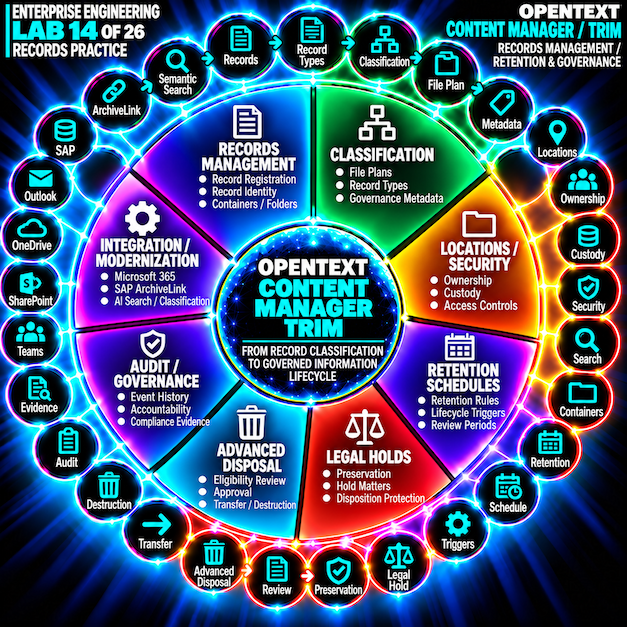
OpenText Content Manager supports this discipline through record registration, unique record numbers, titles, metadata, record types, containers and security controls.
For example, a government agency may manage contracts, correspondence, permits and administrative decisions. Each record must remain identifiable, searchable and accountable regardless of whether it originated electronically or exists in physical form.
Record Types establish the characteristics and behavior of managed objects, while containers and folders provide organizational structure. Ownership, custody and access permissions determine who is responsible for records and who may interact with them.
Engineering principle: Business records require controlled identity, ownership and lifecycle management.
2. Classifications, Record Types and Locations
Reliable records governance depends on consistent information architecture.
OpenText Content Manager uses three important structures:
- Classifications: Organize records within controlled hierarchies and file plans.
- Record Types: Define how different categories of record objects behave.
- Locations: Represent people, positions, organizations, groups and physical places associated with records.
Together, these structures connect business information to organizational responsibilities.
A contract, for example, may be classified under procurement, assigned an appropriate Record Type, associated with a responsible department and secured according to its sensitivity.
Structured metadata enables accurate searching, retrieval, reporting and application of governance rules. Without consistent classification, records become difficult to locate and retention policies become harder to enforce.
Engineering principle: Structured classification connects business information to consistent records governance.
3. Retention Schedules and Legal Holds
Records cannot be retained indefinitely without justification, nor can they be destroyed simply because they are no longer actively used.
Retention Schedules define how long records must be preserved, often using business events, retention triggers and specified periods.
A procurement record, for example, might have a retention period beginning when a contract expires. Its eligibility for disposition depends on the applicable schedule and organizational requirements.
Legal and administrative holds introduce an additional layer of control.
Even when a record completes its normal retention period, an active hold may prevent its destruction because of litigation, investigation, regulatory preservation or another authorized obligation.
This creates an important distinction between retention eligibility and permission to dispose.
Engineering principle: Retention compliance requires policies, lifecycle events and preservation obligations to remain aligned.
4. Advanced Disposal and Audit Governance
Records disposition must be deliberate, authorized and traceable.
OpenText Content Manager supports controlled disposition through retention evaluation, hold verification, review procedures, approval controls and documented lifecycle actions.
The Lab demonstrates a simplified governance sequence:
Identify
Check Hold
Review
Approve
Evidence
Authorized outcomes may include transfer, continued archival preservation or destruction, depending on the applicable policy and record status.
Audit trails provide evidence of record registration, metadata changes, classification, access activity, hold placement and disposition actions, subject to the configured auditing capabilities.
These controls are particularly important in government, legal, financial and other regulated environments where organizations may need to demonstrate not only what happened to a record, but also who authorized the action.
Engineering principle: Records disposition must be authorized, traceable and defensible.
5. Enterprise Integration and Modernization
Modern records governance extends beyond a standalone records repository.
OpenText Content Manager can participate in broader enterprise environments through integrations and supporting technologies, including Microsoft 365, SharePoint, Teams, Outlook, OneDrive and SAP-related archiving scenarios.
Additional integration surfaces may support intelligent capture, OCR, semantic search, automated classification and physical records tracking using barcodes.
These capabilities depend on the installed components, licensing, configuration and integration architecture. They should not be confused with universally available core records-management functionality.
The larger engineering objective is to preserve classification, metadata, security, retention rules and audit continuity as information moves between business systems.
Modernization succeeds when improved accessibility and automation do not weaken governance.
Engineering principle: Modern enterprise collaboration must not compromise records governance.
From Principle to Practice — Explore Lab 14
The concepts discussed here can be explored through the corresponding Samuels Enterprises Enterprise Engineering Lab.
LAB 14 — OPENTEXT CONTENT MANAGER / TRIM
[ LAB 14 INTERACTIVE EXPERIENCE ]

The Lab demonstrates records registration, classification, retention schedules, legal holds, disposition review, audit and information governance through an independent Samuels Enterprises engineering experience.
It is not an official OpenText product interface or a representation of vendor affiliation.
Engineering Conclusion
OpenText Content Manager / TRIM illustrates why enterprise records management extends far beyond document storage.
Classification establishes organizational meaning. Record Types and Locations establish structure and responsibility. Retention schedules define preservation obligations. Legal holds protect information from premature destruction. Advanced Disposal and auditing establish accountability.
Together, these capabilities support the controlled lifecycle of business information.
The fundamental engineering principle is that enterprise records governance is reliable only when classification, retention, security, preservation, disposition and audit remain consistent throughout the records lifecycle.
As the Enterprise Engineering Series continues into Lab 15, these principles provide the foundation for examining the next established technology within the 26-Lab sequence.