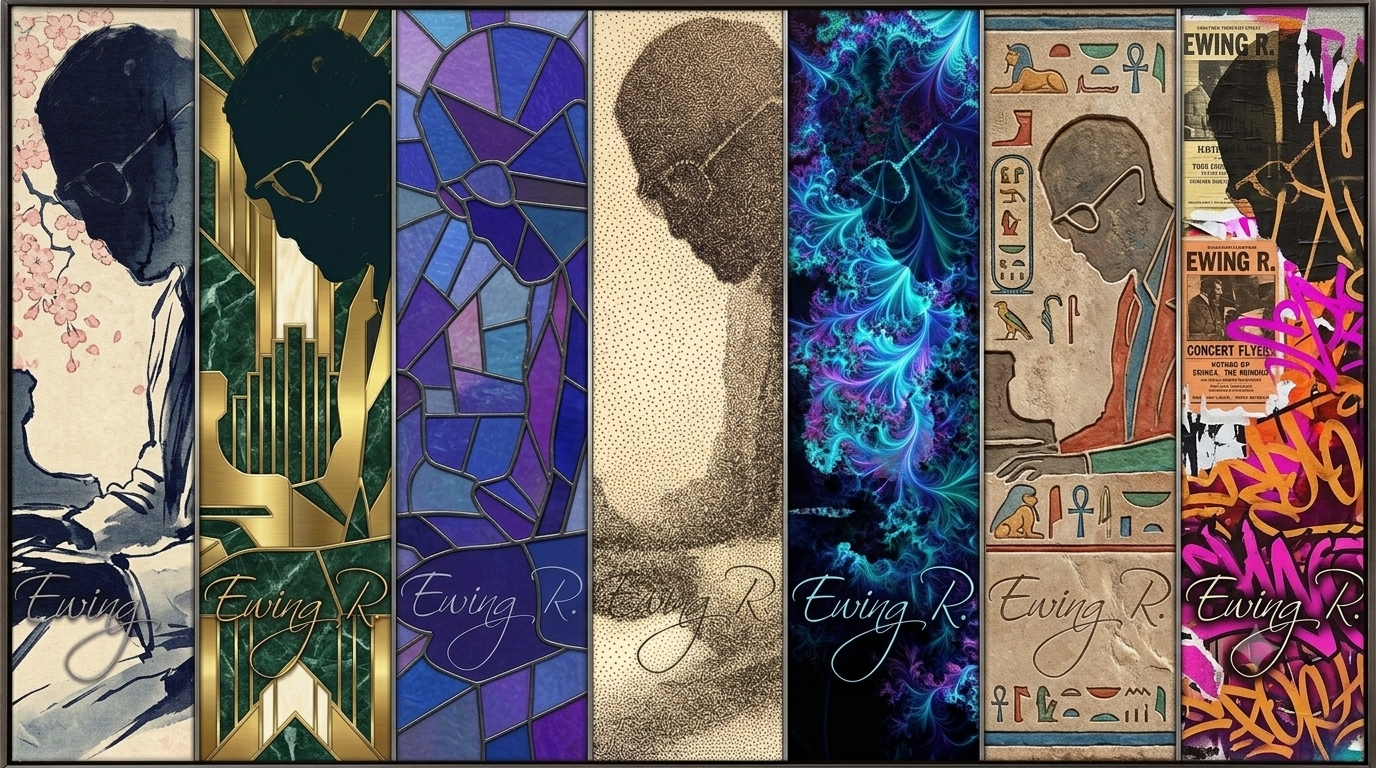

Great work is not simply a collection of excellent parts.
It is a collection of excellent parts that all belong together.
That distinction is coherence.
A song may have exceptional vocals, brilliant lyrics, strong production and beautiful instrumentation, yet still feel incomplete when those elements pull in different directions. A business may possess talent, technology, products and capital, yet remain ineffective when those resources do not support one clear purpose.
A life can be the same way.
We can possess intelligence, experience, talent, pain, ambition, memories, failures and victories without understanding how they connect. From the outside, they may appear to be separate or even contradictory chapters.
Coherence begins when we recognize that they belong to the same book.
Psychologists use the term narrative coherence to describe whether a person’s life story makes sense—not only whether the events can be understood, but whether their meaning can also be understood. Research into narrative identity suggests that the stories people construct about themselves are connected to identity, purpose and psychological well-being.¹
This does not mean inventing a pleasant explanation for everything that happened. It means deciding what each experience taught us, revealed, cost and prepared us to become.
A Life That Did Not Move in a Straight Line
My life has never been a straight line.
I developed my identity through music, production and technology while still young. Over time, I worked in recording studios, entertainment, software engineering, business consulting and systems development. I lived and created in Los Angeles, San Francisco, Phoenix, Chicago, Miami, New York and New Jersey.
I learned how records were made, how companies were structured, how technology solved problems and how intellectual property could continue producing value long after the original work was completed.
I also learned what it meant to make a great deal and then lose far more. I died in 1995 for 2.5 minutes and was resucitated.
I lost businesses, equipment, opportunities, relationships, freedom, time and years that can never be returned. I endured a conviction that I maintain was wrongful and unlawful, followed by more than six and a half years in the Arizona Department of Corrections. After my release in June 2023, I remained in federal immigration custody for another 3 months before being deported to Belize—the country of my birth, but one I had left as a child.
Any one of those events could be viewed as an ending.
For a time, they probably appeared like disconnected ruins: a technology career, a music career, business plans, handwritten lyrics, hard drives filled with unfinished work, legal records, family memories, incarceration and an uncertain return to Belize.
Yet ruins can become foundations when we understand how the pieces fit.
My life was not incoherent because it contained drastic changes. It only appeared incoherent while I was still too close to the events to see their relationship.
The producer, engineer, songwriter, consultant, technologist, businessman and survivor were never separate people.
They were separate expressions of the same person.
Coherence Does Not Erase the Damage
There is a dangerous misunderstanding of resilience that treats recovery as if nothing serious happened.
That is not resilience.
Resilience does not require us to minimize loss, pretend injustice was beneficial or celebrate every wound. Meaning does not excuse the people or systems responsible for causing harm.
Coherence does something different.
It places the damage inside a larger structure where it no longer possesses the authority to define the entire life.
Research on autobiographical coherence indicates that organizing memories into an understandable personal account may support meaning, self-confidence, optimism and psychological well-being. Studies of narrative identity have also examined redemptive sequences—stories in which hardship eventually produces growth, insight or transformation.²
The point is not that the loss becomes good.
The point is that the loss does not get the final word.
I cannot recover the years taken from me or reproduce every opportunity that disappeared. What I can do is decide what the surviving parts will build together.
That is where coherence becomes power.
Rebuilding as One
When people speak of rebuilding, they often mean recreating what existed before the destruction.
I am not interested in rebuilding my former life exactly as it was.
The old structure contained valuable parts, but they often operated independently. Music was treated as music. Technology was technology. Business was business. Publishing, media, intellectual property and personal history occupied separate spaces.
The stronger structure brings them together.
My music is connected to publishing ownership. Publishing is connected to master ownership. Master ownership is connected to licensing. Licensing is connected to technology. Technology is connected to vocal identity, catalog management and preservation.
The catalog is connected to my history. My history is connected to the public meaning of the work. The work is connected to businesses designed to protect, market and develop it.
That is coherence.
A coherent system is not created merely by gathering impressive components. It depends on the relationships among those components and whether they support a unified purpose.³
For me, rebuilding stronger has meant refusing to leave my abilities scattered.
Everything must now contribute to everything else.
The Love Letters Collection
The Love Letters Collection is one of the clearest expressions of coherence I have ever created.

It consists of seven albums:
Faithfully.
Hopefully.
Passionately.
Truthfully.
Unconditionally.
Gracefully.
Respectfully.
Each album contains nine songs, forming a 63-song collection written, arranged, composed, performed and produced by me.
Each song must stand independently. It needs its own emotional reason for existing, lyrical story, vocal character, rhythm, instrumentation and potential value for film, television, advertising and visual media.
But excellence at the song level is not enough.
The songs must belong together.
The album titles are not random words chosen because they sound elegant. Together, they describe different ways love is expressed, tested, remembered, desired and understood.
Faithfully speaks to commitment.
Hopefully speaks to expectation.
Passionately speaks to intensity.
Truthfully speaks to honesty.
Unconditionally speaks to acceptance.
Gracefully speaks to dignity and emotional maturity.
Respectfully speaks to value, boundaries and regard.
They are separate emotional positions within one human conversation.
That is coherence.
The Collection as a Life Story
These records are love songs, but they are also evidence.
They show what remained inside me through decades of change.
Some ideas began years ago. Some reflect a younger man learning what love meant. Others carry the perspective of a man who has experienced success, grief, separation, incarceration, return, rebuilding and a greater awareness of time.
The songs are not presented chronologically, yet they form an emotional autobiography.
They contain longing and certainty, devotion and disappointment, memory and anticipation, vulnerability and strength.
They reveal the person I was, the person I became and the person I am still becoming.
Research on narrative identity suggests that identity develops not from isolated events alone, but through the way people interpret experiences across time and connect them to a continuing sense of self.⁴
That is what The Love Letters Collection does musically.
It does not claim that every relationship succeeded, every promise was kept or love prevented hardship.
It says something more durable: through everything, my capacity to feel, write, create and communicate remained alive.
Technology That Belongs
The vocal technology used in this project is another part of that coherence.

Through Skyview, I developed proprietary vocal-synthesis technology designed to capture, preserve and extend the characteristics of my own vocal identity and original timbre.
It is not technology used to replace my authorship or remove me from the process.
It is technology created to bring more of me into the work.
My software-engineering background belongs with my music-production experience. My understanding of systems belongs with my concern for preserving identity. My production judgment belongs with the technology’s output. My songwriting belongs with my voice.
The tool, engineer, producer, composer and performer originate from one creative center.
The importance is not merely that the parts are advanced.
It is that they belong together.
Returning to Belize
My return to Belize is also part of the collection’s meaning.
I did not return according to the plan I would have chosen. I returned after imprisonment, federal custody and deportation, carrying significant losses and the responsibility of rebuilding almost everything.
Yet Belize is not merely where I landed after something ended.
It is becoming the place where everything is being brought together.
The country of my birth now intersects with my international experience. Hollywood experience intersects with Caribbean culture. Silicon Valley systems thinking intersects with the realities of building companies in Belize. A catalog created across decades can now be organized, owned and developed from here.
The apparent reversal contains a larger alignment.
I returned to the beginning to assemble the complete structure.
That does not make every circumstance just.
It makes my response intentional.
From Collection to Body of Work
A collection accumulates.
A body of work communicates.
Thousands of songs without a system may demonstrate productivity. Thousands of ideas without organization may demonstrate imagination. Numerous companies without a unified purpose may demonstrate ambition.
Coherence turns volume into meaning.
My larger catalog contains tens of thousands of registered and documented works, with a much greater archive of intellectual-property titles and concepts. Yet its value cannot be measured by quantity alone.

The works must be organized. The rights must be controlled. The brands must have defined roles. The technology must support the art. The art must support the story. The story must support the mission.
The Love Letters Collection is therefore more than seven albums released together. It demonstrates what happens when experience, craftsmanship, ownership, technology, emotion and strategy begin functioning as one.
Coherence Is Available to Everyone
Most people have parts of themselves that appear not to fit.
A past career unrelated to the present. A failure that interrupted the expected future. A neglected talent. A relationship that changed everything. A period of grief, displacement, poverty, incarceration, illness or rejection.
A dream postponed so long that it seems to belong to somebody else.
Coherence asks us to look again.
What did that career teach you?
What ability survived the failure?
What did the loss clarify?
What discipline was developed in isolation?
What part of your identity kept appearing no matter where life placed you?
A coherent life does not require every event to have been desirable. It requires us to determine what we will do with what remains.
The psychological concept known as a sense of coherence describes life through three qualities: comprehensibility, manageability and meaningfulness. In simple terms, we face life more effectively when we can understand what is happening, recognize the resources available and identify a reason to continue engaging with the challenge.⁵
We may not control every event.
But we can work toward understanding the pattern.
Nothing Was Wasted
I have made a lot.
I have lost a whole lot more.
But I no longer measure my life only by what disappeared.
The knowledge remained.
The songs remained.
The technical ability remained.
The business instincts remained.
The memories remained.
The determination remained.
The voice remained.
Most importantly, the ability to bring all of those things together remained.
The producer can strengthen the businessman. The businessman can protect the songwriter. The technologist can preserve the performer. The survivor can deepen the philosopher. The philosopher can give language to the pain.
The pain can provide emotional truth to the art. The art can become an asset. The asset can create opportunity. The opportunity can build institutions that may outlive the person who created them.
This is not simply recovery.
It is integration.
When the Parts Finally Belong
Great work is not simply a collection of excellent parts.
It is a collection of excellent parts that all belong together.
The same is true of a great life.
Coherence does not mean the road was straight, the process painless or every injustice corrected.
It means we have discovered the central thread.
My central thread is creation.
It ran through the studios, technology companies, businesses, losses, incarceration, handwritten songs, hard drives, registrations, mixes, masters and plans.
It followed me back to Belize.
Now it runs through all 63 songs of The Love Letters Collection.
Seven albums. Seven emotional perspectives. Sixty-three individual works. One voice. One ownership structure. One evolving technology. One life behind them.
Excellent parts that finally belong together.
That is coherence.
And that is what it means to rebuild stronger than ever.
Until Next Time…
I Am,
Ewing R. Samuels III

References
- Research on narrative coherence and narrative identity, published through the U.S. National Library of Medicine and National Institutes of Health.
- Research on autobiographical coherence, redemptive narratives and psychological well-being, published through the U.S. National Library of Medicine and National Institutes of Health.
- Stanford University research and writing on coherence within complex systems and design.
- Research on autobiographical memory and the development of identity across time, published through the U.S. National Library of Medicine and National Institutes of Health.
- Research based on Aaron Antonovsky’s theory of sense of coherence: comprehensibility, manageability and meaningfulness.