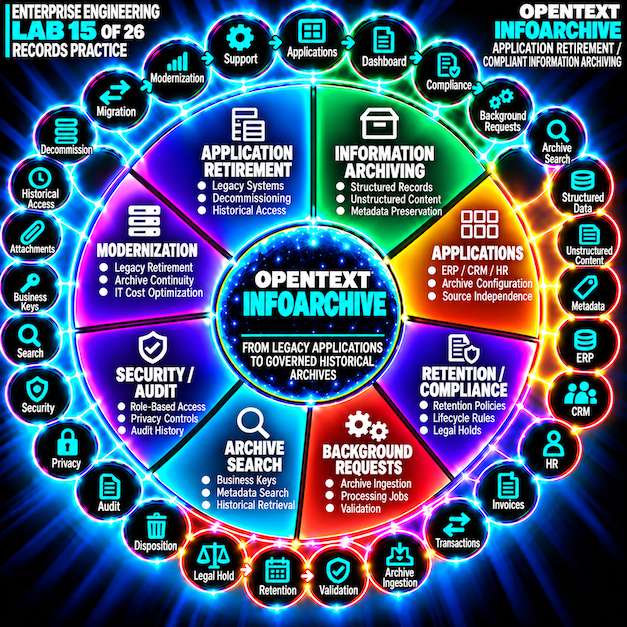

Enterprise Engineering Series | Records Practice | Lab 15 of 26
OpenText InfoArchive
By Ewing R. Samuels III | Samuels Enterprises, LLC
Enterprise information does not lose its value simply because the application that created it becomes obsolete. Organizations often maintain aging software, databases, and infrastructure because historical business records must remain accessible for operational, legal, financial, and regulatory purposes.
In Lab 14, we examined how OpenText Content Manager / TRIM supports records classification, retention, legal holds, and defensible disposition. Lab 15 extends those governance principles into enterprise information archiving and application retirement using OpenText InfoArchive.
The engineering challenge is straightforward: How can an organization retire expensive legacy applications without losing the information, relationships, security controls, and compliance obligations associated with them?
1. Enterprise Information Archiving
OpenText InfoArchive provides an enterprise archiving approach for preserving structured and unstructured information independently of the applications that originally managed it.
Consider an organization replacing an aging Enterprise Resource Planning (ERP) system. Although the new platform handles current transactions, the organization may still need years of historical invoices, purchase orders, financial transactions, and supporting documents.
Maintaining the original ERP environment solely for historical access introduces licensing costs, infrastructure dependencies, security exposure, and administrative overhead.
An independent archive addresses this challenge by preserving business information, metadata, and historical relationships in an environment designed for long-term access.
Engineering principle: Information value must survive application obsolescence.
2. Application Retirement and Decommissioning
Application retirement involves considerably more than uninstalling software or deleting a database. It requires a controlled process for identifying, extracting, transforming, validating, and preserving information before the original system is decommissioned.
The InfoArchive Lab demonstrates this concept through simulated enterprise application archives, including Accounts Receivable, Human Resources Legacy, Invoice Archive, Legacy CRM, Document Repository, ERP History, Enterprise Reports, and Customer Service Archive.
A practical retirement lifecycle follows:
CONCEPTUAL APPLICATION RETIREMENT LIFECYCLE
Legacy Business Application
Information Extraction and Transformation
Archive Ingestion and Validation
Retention, Security and Search
Governed Historical Archive and Application Retirement
This lifecycle requires verification of record completeness, business relationships, metadata accuracy, access permissions, and applicable retention requirements. The stages represent an engineering process rather than an automatically executed product workflow.
Engineering principle: Application retirement succeeds only when information continuity has been demonstrated.
3. Retention, Compliance and Legal Holds
Archiving information does not eliminate the organization’s responsibility to govern it.
Historical information may remain subject to financial retention requirements, employee-record obligations, litigation holds, privacy regulations, and internal corporate policies.
The Lab models several retention scenarios:
| Policy | Engineering purpose |
|---|---|
| FIN-07 | Duration-based financial retention |
| HR-TERM | Event-driven employee-record retention |
| LEGAL-HOLD | Suspension of normal disposition |
| PERM-CORP | Permanent corporate preservation |
These identifiers are illustrative Lab policies, not standard OpenText product defaults.
A critical distinction exists between retention expiration and authorized disposition. A record reaching the end of its retention period does not necessarily become eligible for immediate deletion. Legal holds, policy exceptions, and approval requirements may prevent disposition.
Role-based access controls, privacy protections, and audit histories must also remain effective after the original application is retired.
Engineering principle: Application retirement must not terminate information governance.
4. Background Requests and Archive Operations
Enterprise archiving involves operational processes that may handle substantial volumes of records and documents.
The Lab’s Background Requests area illustrates asynchronous processing activities such as archive ingestion, package validation, retention assignment, and disposition review.
Examples include BR-1042 for Invoice Archive ingestion, BR-1041 for Legacy CRM validation, BR-1040 for Human Resources retention processing, and BR-1039 for ERP History disposition review.
These simulated requests demonstrate why enterprise archive operations require identifiable jobs, processing status, timestamps, error reporting, validation results, and administrative accountability.
Engineers must be able to distinguish successful processing from incomplete or failed operations. An archive package that was submitted is not necessarily an archive package that was successfully validated.
Operational traceability becomes especially important when retiring systems containing millions of records or information subject to regulatory oversight.
Engineering principle: Archive operations require controlled processing, validation, and traceability.
5. Searchable Archives and Enterprise Modernization
Preserved information remains valuable only when authorized users can locate, interpret, and retrieve it.
The InfoArchive Lab demonstrates configurable archive searching by application, record identifier, customer or subject, record type, full text or metadata, and date range.
For example, a historical customer transaction from a retired CRM system may retain its original business key, source application, associated documents, retention policy, legal hold status, and access permissions.
This historical context enables organizations to respond to audits, customer inquiries, financial investigations, and operational research without maintaining the original CRM application.
Independent archiving also supports broader modernization initiatives, including legacy database retirement, infrastructure consolidation, and cloud or hybrid transformation. The actual capabilities depend on the archive architecture, implementation, and configured integrations.
Engineering principle: Retired applications must not mean inaccessible business history.
From Principle to Practice — Explore Lab 15
The concepts discussed here can be explored through the corresponding Samuels Enterprises Enterprise Engineering Lab.
LAB 15 — OPENTEXT INFOARCHIVE
LAB 15 INTERACTIVE EXPERIENCE

The Lab demonstrates application retirement, historical information preservation, retention policies, legal holds, background processing, archive search, and continued access to governed information.
This is an independent Samuels Enterprises engineering demonstration, not an official OpenText interface or vendor-affiliated deployment. All demonstrated application records and operational requests are illustrative.
Engineering Conclusion
Enterprise modernization is not simply the replacement of outdated software. It requires preserving the business information, historical context, security requirements, and regulatory obligations associated with systems reaching the end of their operational lives.
OpenText InfoArchive illustrates an architectural approach for separating valuable historical information from the applications that originally produced it.
Successful application retirement depends on verified information integrity, governed access, searchable archives, defensible retention, and operational accountability.
Applications may reach the end of their operational lifecycle. The information they produced may continue to hold business, legal, and historical value. Enterprise architecture must preserve that value independently of the original application.
Lab 16 will continue the Enterprise Engineering series with the next platform in the established 26-Lab sequence, extending the examination of enterprise information architecture and governance.