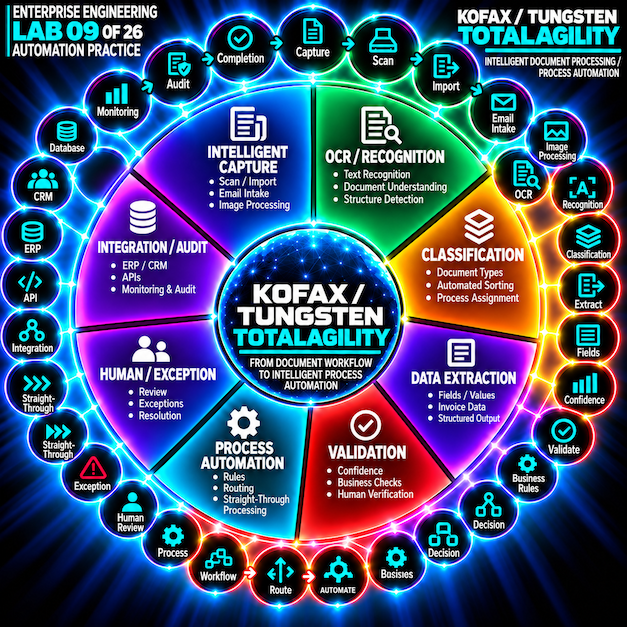

Enterprise Engineering Series | Automation Practice | Lab 09 of 26 By Ewing R. Samuels III | Samuels Enterprises, LLC
From Document Workflow to Intelligent Process Automation
The first eight Enterprise Engineering Labs examined how organizations capture, organize, secure, route and govern business information.
Lab 08, Hyland Perceptive Content, demonstrated how documents become controlled operational work through indexing, workflow queues and human review.
But what happens when incoming information exceeds an organization’s ability to process it manually?
This question moves Enterprise Engineering from Enterprise Content Management (ECM) into Automation.
Kofax, now Tungsten Automation, provides a foundation for examining this transition through TotalAgility, a platform combining intelligent document processing, business rules, workflow orchestration and enterprise integration.
The objective is no longer simply managing documents. It is transforming incoming information into controlled business actions.
1. Intelligent Capture and Recognition
Traditional document capture brings information into an enterprise system. Intelligent capture prepares that information for automated processing.
Documents arrive through scanners, email, uploads and other digital channels. Optical Character Recognition (OCR) converts images into machine-readable text, while classification identifies document types.
The engineering sequence becomes:
CAPTURE → RECOGNIZE → CLASSIFY → EXTRACT → PROCESS
An incoming invoice, for example, can be classified automatically, with supplier information, invoice numbers, dates and payment amounts extracted into structured data.
Instead of requiring employees to enter every value manually, the platform can perform repetitive processing.
Engineering Principle: Automation cannot exceed the quality of the information entering the process.
2. Validation, Confidence and Business Rules
Extracting information does not guarantee accuracy.
An invoice amount may be readable but inconsistent with its purchase order. A customer identifier may be extracted correctly but absent from the enterprise database.
TotalAgility workflows can evaluate information through confidence assessments, validation rules and human verification.
Three outcomes become possible:
- High confidence: Validated transactions proceed automatically.
- Low confidence: Uncertain information enters human review.
- Business exception: Conflicting or incomplete information requires resolution.
Business rules determine subsequent actions, including approvals, routing and system updates.
Engineering Principle: Good automation recognizes uncertainty rather than ignoring it.
3. Process Orchestration — Connecting Information to Action
Document recognition alone does not constitute enterprise automation.
The greater engineering challenge is coordinating activities, decisions, people and systems into a complete business process.
TotalAgility connects document processing with automated services, human tasks and enterprise applications.
EVENT → DATA → RULE → DECISION → ACTION → COMPLETION
For example, an approved invoice may automatically update an accounting system, notify a department and preserve the transaction record.
Each activity requires a defined sequence, responsibility and completion state.
Engineering Principle: Automation is not a collection of scripts. It is controlled process orchestration.
4. Human-in-the-Loop and Exception Management
Enterprise automation should not be measured solely by how many employees it removes from a process.
Some decisions require interpretation, authorization and professional judgment.
Unreadable documents, missing fields, duplicate transactions and integration failures must trigger controlled exception handling rather than incorrect automated outcomes.
The architecture follows three pathways:
HIGH CONFIDENCE → AUTOMATE
LOW CONFIDENCE → HUMAN REVIEW
EXCEPTION → RESOLVE → RETURN TO PROCESS
This approach enables straight-through processing for predictable transactions while preserving human authority over uncertainty.
Engineering Principle: The best automation knows when not to automate.
5. Enterprise Integration and Accountability
Automation creates operational value when information reaches the systems responsible for business transactions.
These may include ERP platforms, CRM systems, financial applications, databases and enterprise content repositories.
However, integration must remain observable and auditable.
Enterprise architects need visibility into processing times, failed transactions, exception rates, workflow bottlenecks and system updates.
Every automated transaction should preserve sufficient evidence to establish what entered, which rules executed, what decisions occurred and what resulted.
INPUT → MACHINE ACTION → BUSINESS DECISION → SYSTEM UPDATE → AUDIT
Engineering Principle: Machine execution still requires accountability.
From Principle to Practice — Explore Lab 09
The concepts discussed here can be explored through the corresponding Samuels Enterprises interactive Engineering Lab.
ENTERPRISE ENGINEERING | LAB 09 OF 26
Kofax / Tungsten TotalAgility

Explore intelligent capture, document recognition, classification, extraction, validation, process automation and human exception handling.
The Larger Engineering Lesson
Kofax / Tungsten TotalAgility illustrates a fundamental progression in enterprise systems engineering.
ECM establishes control over information. Automation extends that control into business process execution.
Modern intelligent document processing, AI-assisted recognition and workflow orchestration expand what machines can accomplish. Yet reliable automation still depends on validated information, defined rules, human oversight and traceable outcomes.
Automation should remove repetition without removing accountability.
The next engineering challenge is coordinating automation across multiple applications, departments and enterprise systems without losing control over dependencies, failures and operational consistency.
That question carries the Enterprise Engineering series into its next Automation Lab.