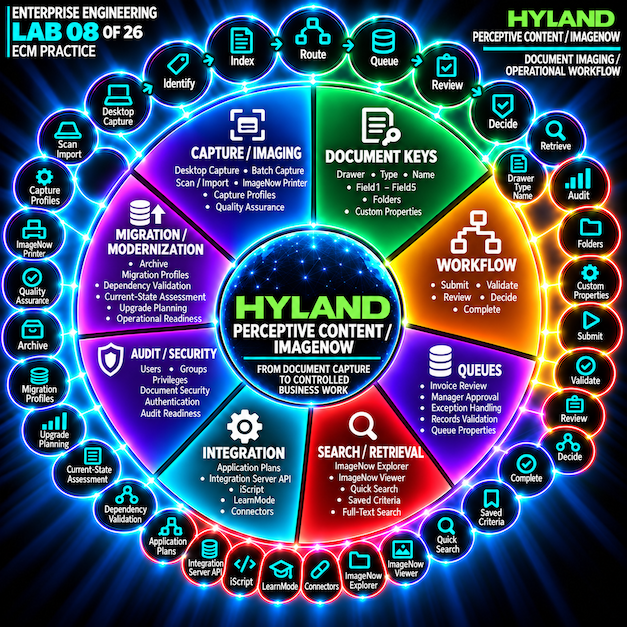

Enterprise Engineering Series | ECM Practice | Lab 08 of 26
Hyland Perceptive Content / ImageNow
By Ewing R. Samuels III | Samuels Enterprises, LLC
Enterprise content management becomes operational when documents stop being passive files and begin participating in business processes.
Across the earlier ECM Labs, we established repositories, metadata, governance, workflow, integration and controlled access.
Hyland Perceptive Content—historically known as ImageNow—brings those ideas directly into document-driven operations.
The engineering question becomes:
How does the enterprise transform incoming documents into identifiable, searchable, actionable and governed business work?
The architecture is:
CAPTURE → IDENTIFY → INDEX → ROUTE → QUEUE → REVIEW → DECIDE → COMPLETE → RETRIEVE → AUDIT
That is where document management becomes operational engineering.
Capture Is More Than Scanning
Perceptive Content can receive documents through desktop capture, batch capture, scan/import operations, ImageNow Printer and configured capture profiles.
But digitization alone is not enough.
The stronger sequence is:
CAPTURE → PROFILE → QUALITY ASSURANCE → IDENTIFY → COMMIT
DIGITIZATION WITHOUT IDENTIFICATION CREATES DIGITAL CLUTTER.
The real question is not simply whether a document was scanned.
It is whether it was captured correctly, identified correctly and committed into the right business context.
Document Keys Create Business Identity
Perceptive Content uses document keys and metadata structures such as:
Drawer → Type → Name → Fields → Custom Properties
These values transform an anonymous file into identifiable enterprise information.
The progression becomes:
DOCUMENT → BUSINESS KEYS → CLASSIFICATION → SEARCHABILITY → PROCESS CONTEXT
A document becomes operationally useful when the enterprise knows what it is and where it belongs.
This identity affects routing, retrieval, integration, security and governance throughout the rest of its lifecycle.
Connecting Documents to Business Applications
Enterprise documents rarely exist separately from business transactions.
An invoice may belong to an ERP record. An employee document may connect to an HR system. A customer application may belong to an account or case.
Perceptive Content Application Plans help connect those worlds:
BUSINESS APPLICATION ↔ BUSINESS VALUES ↔ APPLICATION PLAN ↔ DOCUMENT KEYS ↔ MANAGED CONTENT
The business application understands the transaction.
The content system understands the document.
The architecture connects them.
BUSINESS CONTEXT SHOULD HELP IDENTIFY THE CONTENT THAT BELONGS TO IT.
Workflow Turns Documents Into Responsibility
Once a document is captured and identified, the next question is:
What needs to happen to it?
A simplified workflow might be:
SUBMIT → VALIDATE → REVIEW → DECIDE → COMPLETE
The important lesson is not merely that workflow exists.
Workflow establishes responsibility.
A controlled document process should show where work is, who owns the next action, what decision is required and what happens afterward.
WORKFLOW SHOULD TURN DOCUMENT ARRIVAL INTO CONTROLLED RESPONSIBILITY.
Queues Make Work Visible
Queues are where workflow becomes work management.
Examples include:
Invoice Review
Manager Approval
Exception Handling
Records Validation
The operational pattern becomes:
DOCUMENT → WORKFLOW → QUEUE → ASSIGNEE → DECISION → NEXT ACTION
Queues expose workload, ownership, aging, bottlenecks and exceptions.
That leads to one of the strongest lessons in this Lab:
A PROCESS IS NOT CONTROLLED IF NOBODY CAN SEE WHERE THE WORK IS WAITING.
Good Retrieval Begins at Capture
Search and retrieval appear downstream, but their effectiveness begins much earlier.
ImageNow Explorer, ImageNow Viewer, indexed searches and folder structures can help authorized users locate managed documents.
The architecture is:
BUSINESS KEY → INDEX → QUERY → MATCH → AUTHORIZED DOCUMENT
Poor capture and inconsistent indexing create retrieval problems later.
GOOD RETRIEVAL BEGINS AT CAPTURE.
The quality of information entering the system directly affects the quality of information coming back out.
Integration Prevents Another Information Silo
Perceptive Content environments can integrate with ERP, finance, HR and other enterprise applications through capabilities such as Application Plans, Integration Server API, iScript, LearnMode and connectors.
The goal is continuity of business context.
THE CONTENT SYSTEM SHOULD ADD DOCUMENT CONTEXT TO THE BUSINESS PROCESS, NOT CREATE ANOTHER DISCONNECTED WORLD.
The repository may remain authoritative for the document while another enterprise application remains authoritative for the transaction.
Both can coexist within a properly engineered architecture.
Security, Governance and Evidence
Operational processing must remain authorization-aware.
Users, groups, privileges, document types and workflow rights establish who may see content and what actions they may perform.
Conceptually:
USER → GROUP → PRIVILEGE → CONTENT → AUTHORIZED ACTION
Documents may later enter records and retention structures, but the larger lesson here is continuity of governance.
The system should also preserve evidence:
CAPTURE → ACTION → DECISION → USER → TIME → RESULT → AUDIT
A controlled document process should be able to explain what happened, who acted, when it happened and what resulted.
From Principle to Practice — Explore Lab 08
The concepts discussed here can be explored through the corresponding Samuels Enterprises Enterprise Engineering Lab.
LAB 08 — HYLAND PERCEPTIVE CONTENT / IMAGENOW
[ LAB 08 INTERACTIVE EXPERIENCE ]

EXPLORE LAB 08 →
The article explains the engineering principle.
The Lab demonstrates how that principle appears inside an enterprise system.
Migration Means Moving More Than Documents
Long-lived ECM platforms accumulate configuration dependencies.
Document types, groups, privileges, application plans, capture profiles, custom properties and workflow processes all participate in the functioning system.
Therefore:
ASSESS → MAP → BACKUP → MIGRATE → VERIFY
Moving documents alone does not reproduce a working enterprise application.
A CONFIGURATION MIGRATION IS ONLY SUCCESSFUL WHEN ITS DEPENDENCIES SURVIVE WITH IT.
Migration must validate not just content, but also workflow, security, integration and operational behavior.
Modernization Must Preserve Business Capability
Perceptive Content and ImageNow environments may represent years of accumulated business logic and integration decisions.
Modernization therefore cannot simply mean replacing old technology.
A disciplined path is:
INVENTORY → ASSESS → RATIONALIZE → MODERNIZE → TEST → MIGRATE → VALIDATE → CUTOVER
The objective is to remove technical debt while preserving the business capability embedded in the environment.
MODERNIZATION SHOULD PRESERVE BUSINESS CAPABILITY WHILE REMOVING TECHNICAL DEBT.
The Larger Engineering Lesson
Perceptive Content/ImageNow demonstrates the difference between:
A DIGITAL DOCUMENT REPOSITORY
and:
A DOCUMENT-DRIVEN OPERATING SYSTEM FOR BUSINESS WORK.
The second must answer:
What is the document?
Which transaction does it belong to?
Which business keys identify it?
Which queue owns it?
Who must act next?
What happened to it?
Can it be retrieved later?
Can the organization prove the process was followed?
That produces the larger architectural model:
CAPTURE CORRECTLY → IDENTIFY CLEARLY → ROUTE INTENTIONALLY → WORK VISIBLY → RETRIEVE RELIABLY → GOVERN COMPLETELY
Enterprise document management is therefore not merely the storage of documents.
It is the controlled transformation of incoming content into identifiable, searchable, actionable and governed business information.
The Next Engineering Problem
Document-driven operations expose another limitation.
What happens when the enterprise cannot afford to have people manually identify, classify, extract, route and validate every incoming document?
At sufficient scale, controlled queues are no longer enough.
The architecture must begin automating recognition, extraction, routing and process initiation while preserving human review where judgment or exceptions require it.
The problem therefore moves from:
DOCUMENT-DRIVEN OPERATIONAL CONTROL
toward:
DOCUMENT AUTOMATION AND INTELLIGENT PROCESSING.
That transition takes Enterprise Engineering into the Automation Practice and Lab 09 — Kofax / Tungsten TotalAgility.
The next engineering question becomes:
How much of the document lifecycle can the enterprise automate without surrendering control, accuracy and evidence?