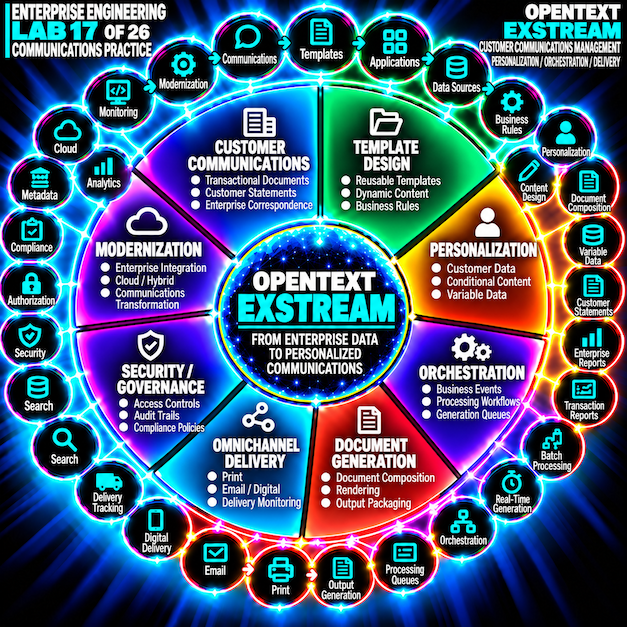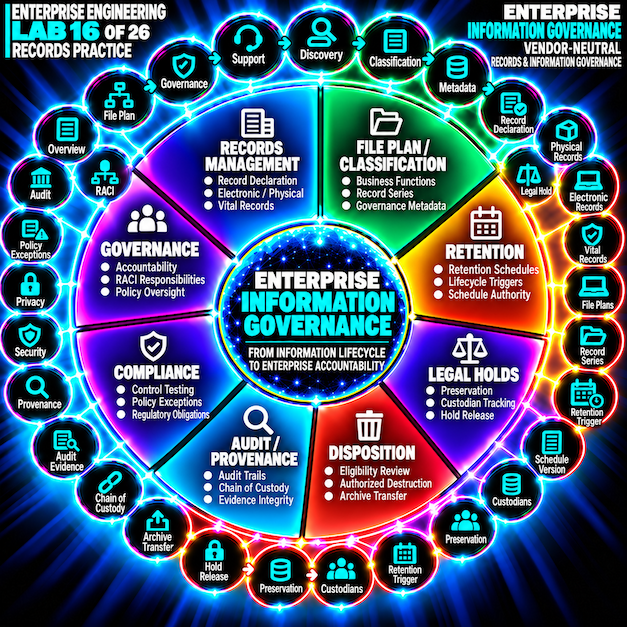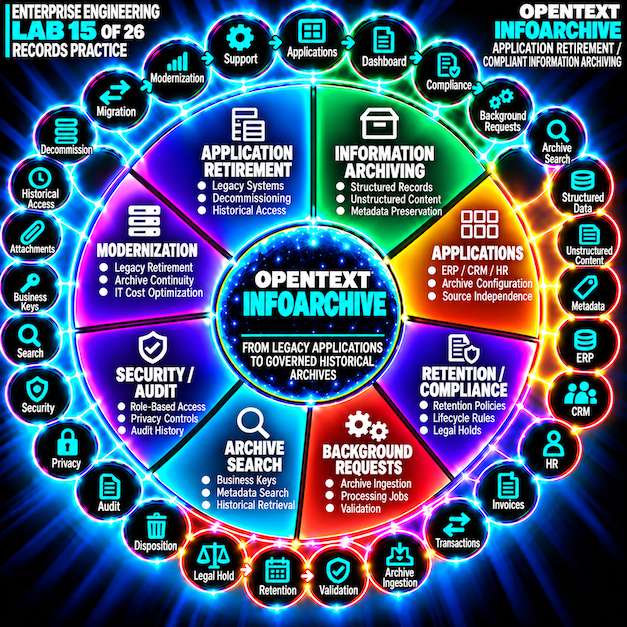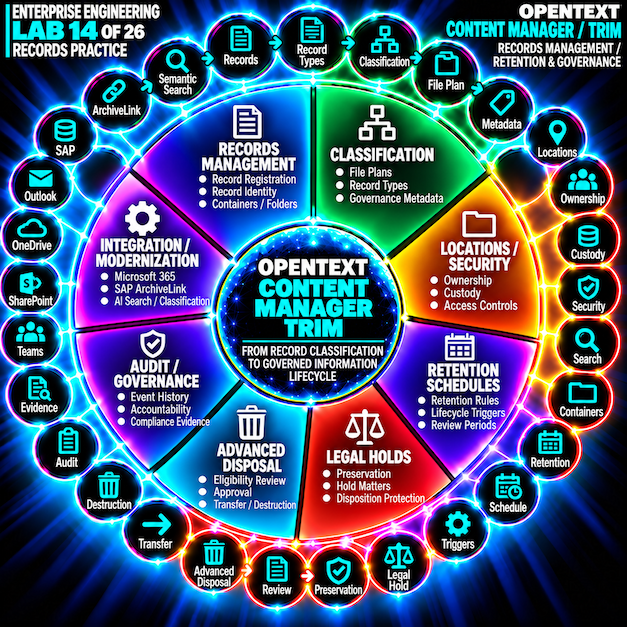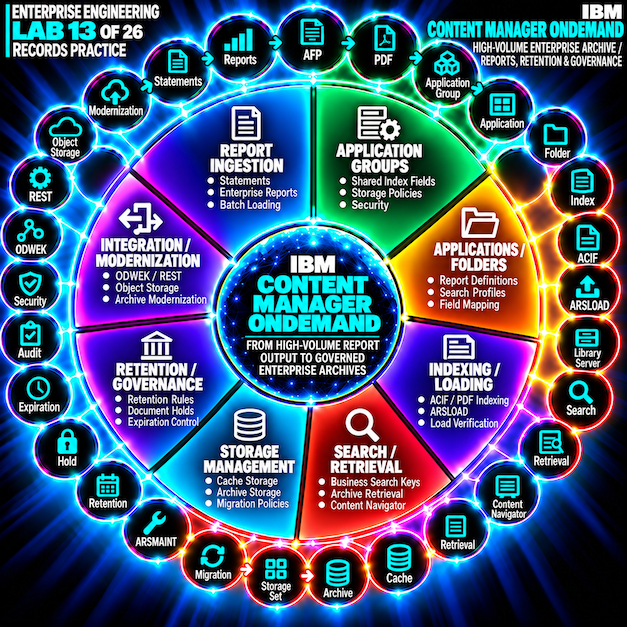

Enterprise Engineering Series | Records Practice | Lab 13 of 26 IBM Content Manager OnDemand (CMOD) By Ewing R. Samuels III | Samuels Enterprises, LLC
Enterprise information management extends beyond capturing, processing and storing documents. Organizations must also preserve enormous volumes of business-generated information while ensuring that records remain searchable, secure, accessible and governed throughout their required lifecycle.
In Lab 12, we examined Oracle Enterprise Capture and the engineering processes behind document ingestion, classification, metadata extraction and repository delivery.
Lab 13 introduces the Records Practice, examining how IBM Content Manager OnDemand (CMOD) addresses high-volume enterprise report archiving, structured indexing, retrieval, retention and information governance.
The engineering challenge shifts from processing incoming documents to maintaining reliable access to business information over time.
1. High-Volume Report Archiving
IBM Content Manager OnDemand is designed to archive and retrieve large volumes of computer-generated business information, including financial statements, invoices, transaction records, customer communications and enterprise reports.
Unlike traditional document capture systems, CMOD primarily manages information already generated by business applications.
Consider a financial institution producing millions of monthly customer statements. Each statement must be archived with sufficient indexing information to support accurate retrieval without requiring employees to search through enormous collections of individual files.
CMOD supports formats such as AFP, PDF and line-oriented reports, using configured loading and indexing processes to organize business output.
Engineering Principle: Enterprise archives must preserve business information without sacrificing retrieval performance.
2. Applications, Application Groups and Folders
CMOD uses a structured information architecture built around three principal components.
Application Groups define shared index fields, database organization, security configurations and storage or retention policies.
Applications define report characteristics, indexing requirements, loading behavior and document presentation.
Folders provide logical search interfaces that allow authorized users to retrieve archived information through mapped index fields.
For example, an employee searching for a customer statement may enter an account number and statement date. CMOD uses the configured folder mappings and application-group indexes to locate the corresponding archived document.
These folders are logical search structures rather than conventional file-system directories.
This separation between report definitions, indexing architecture and user-facing retrieval enables organizations to maintain consistent information structures across large archives.
Engineering Principle: Structured index design enables precise enterprise retrieval at scale.
3. Indexing, Loading and Document Retrieval
CMOD separates searchable indexing information from the underlying archived document objects.
Depending on document format and configuration, indexing processes may use technologies such as ACIF, line-data indexing or PDF indexing to extract business identifiers.
The ARSLOAD utility supports document loading, while CMOD’s Library Server manages archive metadata and database indexes. Object Server components support access to stored report objects.
The resulting architecture connects business search fields with archived information.
However, successful loading does not automatically establish archive reliability.
Engineering verification must confirm that documents were loaded correctly, index values match their intended business records, and authorized users can retrieve the appropriate content.
IBM Content Navigator can provide a user-facing interface for searching and accessing CMOD archives in supported configurations.
Engineering Principle: Archive reliability depends on both accurate indexes and accessible document objects.
4. Retention, Storage and Information Governance
Enterprise archiving introduces responsibilities extending beyond document availability.
CMOD supports configurable storage management, including cache storage, archive storage, storage sets, migration policies and expiration processing.
Retention behavior involves settings such as Life of Data and Indexes, alongside maintenance operations performed through utilities including ARSMAINT.
Advanced configurations may incorporate Enhanced Retention Management and document holds to address additional governance requirements.
A critical engineering distinction exists between storage migration and records disposition.
Moving archived information between storage tiers does not necessarily mean that the information has been deleted. Likewise, expiration eligibility must be evaluated against applicable retention policies and restrictions.
Legal holds and other preservation requirements must be respected before records are disposed of.
Security, audit capabilities and controlled access further support enterprise information governance.
Engineering Principle: Records governance requires retention, storage, access and disposition policies to remain aligned.
5. Enterprise Integration and Modernization
Archived business information becomes more valuable when authorized enterprise applications can retrieve it without requiring users to interact directly with archive infrastructure.
CMOD supports integration approaches involving IBM Content Navigator, the OnDemand Web Enablement Kit (ODWEK), and supported APIs or REST services, depending on the deployment.
These capabilities allow organizations to incorporate archive retrieval into customer service, financial operations and other business processes.
Modernization introduces additional engineering considerations.
Moving an archive to newer infrastructure, cloud environments or supported object-storage configurations requires more than transferring document files.
Index relationships, metadata, security permissions, retention policies and document integrity must remain consistent.
A technically completed migration is not necessarily a successful business migration if users can no longer retrieve their records accurately.
Engineering Principle: Enterprise archive modernization must preserve information integrity and governed retrieval.
From Principle to Practice — Explore Lab 13
The concepts discussed here can be explored through the corresponding Samuels Enterprises Enterprise Engineering Lab.
LAB 13 — IBM CONTENT MANAGER ONDEMAND
INTERACTIVE LAB EXPERIENCE
LAB 13 INTERACTIVE EXPERIENCE

The article explains the engineering principles. The Lab demonstrates how those principles appear within a high-volume enterprise archive, retrieval and records-governance environment.
This is an independent Samuels Enterprises engineering demonstration workspace, not an official IBM product interface.
Engineering Conclusion
Enterprise records engineering is not simply the storage of digital documents.
IBM Content Manager OnDemand illustrates how structured indexing, application groups, controlled loading, archive retrieval and retention management contribute to reliable information governance.
The objective is to ensure that business information remains accurate, secure, accessible and governed throughout its required lifecycle.
Final Engineering Principle: An enterprise archive is reliable only when business information remains accurately indexed, securely stored, accessible, retained and governed throughout its required lifecycle.
As the Records Practice continues into Lab 14, the focus expands from high-volume archive management toward the next records engineering challenge in the established Enterprise Engineering sequence.