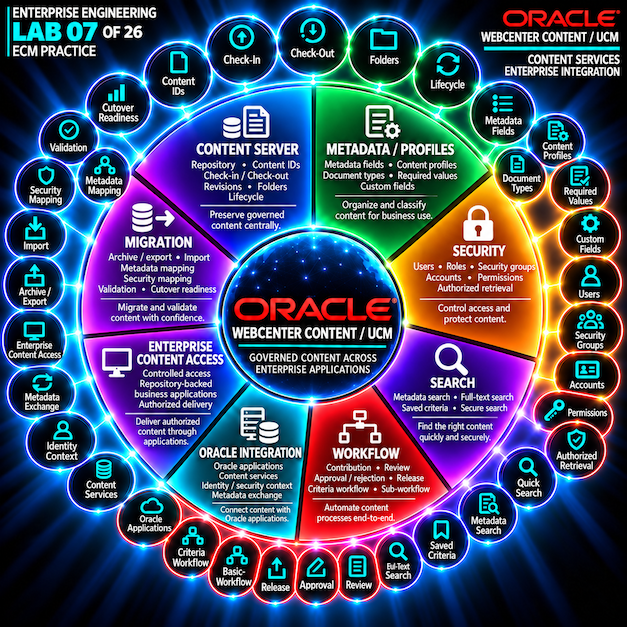

Enterprise Engineering Series | ECM Practice | Lab 07 of 26
Oracle WebCenter Content / UCM
By Ewing R. Samuels III | Samuels Enterprises, LLC
An enterprise may successfully centralize its documents and still create another architectural problem.
The content may be governed in one repository, but employees work through portals, business applications, ERP systems, departmental systems and other enterprise experiences.
That creates the next engineering question:
How can enterprise content serve many applications without losing its identity, security, governance or evidence?
This moves Enterprise Engineering beyond managing information inside a repository toward a broader idea:
CONTENT AS A GOVERNED ENTERPRISE SERVICE.
From Process to Enterprise Access
Lab 06 examined how Laserfiche connects governed information with repeatable business action:
CAPTURE → CLASSIFY → STORE → TRIGGER → ROUTE → ACT → APPROVE → GOVERN → AUDIT
Once more processes depend on managed information, many applications may need access to the same content.
The problem becomes preventing those applications from creating uncontrolled copies, fragmented permissions and conflicting versions.
Oracle WebCenter Content / UCM provides a strong environment for examining that problem.
The Repository Remains Authoritative
At the center is Content Server.
Documents can be checked in, checked out, revised, classified and managed under persistent content identities.
The important principle is continuity:
THE APPLICATION MAY CHANGE.
THE CONTENT IDENTITY SHOULD NOT.
A portal, ERP system or departmental application may expose the same document differently, but each application should not establish its own uncontrolled version.
The repository remains authoritative.
CONTENT ID → REVISION → CONTROLLED CHANGE → NEW REVISION → PRESERVED HISTORY
Change should create a controlled revision rather than destroy the history of the managed object.
Metadata Creates Business Context
Oracle WebCenter Content also demonstrates how metadata provides structure around managed information.
Document types, required values, custom fields and Content Profiles allow different business contexts to interact with a shared repository.
CONTENT TYPE → PROFILE → REQUIRED METADATA → CLASSIFICATION → REPOSITORY CONTROL
A centralized repository does not require every user or application to experience content in exactly the same way.
The underlying information architecture can remain standardized while different business environments present context-appropriate experiences.
Security Must Travel With Access
Once content serves multiple applications, authorization becomes critical.
Users, roles, security groups, accounts and permissions establish who may retrieve managed information.
USER → IDENTITY → ROLE → SECURITY CONTEXT → CONTENT REQUEST → AUTHORIZED RESULT
This leads to a critical rule:
CONTENT SERVICES MUST NOT BECOME A SECURITY BYPASS.
The same principle applies to search.
QUERY → INDEX → METADATA → SECURITY FILTER → AUTHORIZED RESULTS
The system should not simply find relevant information.
It must find information the active user is authorized to retrieve.
Content Services Across the Enterprise
This is where Oracle WebCenter Content becomes especially useful to the Enterprise Engineering story.
BUSINESS APPLICATION
↕
CONTENT SERVICES
↕
CONTENT SERVER
The user experience may exist outside the repository while the repository continues governing:
IDENTITY + METADATA + SECURITY + REVISIONS + GOVERNANCE
The interaction becomes:
APPLICATION REQUEST → AUTHENTICATED CONTEXT → CONTENT SERVICE → REPOSITORY → AUTHORIZED CONTENT → BUSINESS EXPERIENCE
This exposes one of the strongest principles in Lab 07:
THE REPOSITORY CAN REMAIN AUTHORITATIVE EVEN WHEN THE USER EXPERIENCE LIVES SOMEWHERE ELSE.
Instead of every application creating another document silo:
ONE GOVERNED CONTENT SOURCE → MANY CONTROLLED BUSINESS EXPERIENCES
Centralization does not mean every employee must work directly inside the repository.
It means the enterprise maintains authority over the content wherever that content is consumed.
Metadata Must Travel With Meaning
Integration is more than retrieving a file.
Enterprise applications often require the business context surrounding that file.
BUSINESS RECORD ↔ BUSINESS METADATA ↔ MANAGED CONTENT
A document without its business context may still be technically retrievable while being operationally incomplete.
CONTENT INTEGRATION BECOMES MORE USEFUL WHEN BUSINESS CONTEXT MOVES WITH THE CONTENT.
Workflow Without Losing Control
Workflow in Lab 07 supports a focused lesson rather than repeating Laserfiche’s broader automation discussion.
CHECK-IN → CONTRIBUTION → REVIEW → APPROVE / REJECT → RELEASE
Criteria-based workflow also shows how metadata can determine whether content enters a process.
This creates another useful principle:
METADATA CAN DETERMINE BOTH WHAT CONTENT IS AND WHAT HAPPENS TO IT.
Information architecture and process architecture are connected.
From Principle to Practice — Explore Lab 07
The concepts discussed here can be explored through the corresponding Samuels Enterprises Enterprise Engineering Lab.
LAB 07 — ORACLE WEBCENTER CONTENT / UCM

[ LAB 07 INTERACTIVE EXPERIENCE ]
The article explains the engineering principle.
The Lab demonstrates how that principle appears inside an enterprise system.
Migration Is More Than Moving Files
The same governance problem becomes visible when information must move between environments.
An ECM migration is not simply:
COPY FILES → NEW SYSTEM
The real progression is:
SOURCE → EXPORT → MAP → IMPORT → VALIDATE → RECONCILE → CUTOVER
Content may need to retain metadata, classifications, revisions, security structures, relationships and retrieval integrity.
That gives us another Enterprise Engineering principle:
MOVING FILES IS NOT THE SAME AS MIGRATING A CONTENT SYSTEM.
Metadata mapping demonstrates why.
SOURCE FIELD → BUSINESS MEANING → TARGET FIELD
The middle step matters.
Do not merely map labels.
Map meaning.
Migration is partly an information-architecture problem.
Security presents the same challenge. A migration can transfer every document and still fail if users, roles, groups or permissions are translated incorrectly.
Content separated from its access model may no longer represent the same governed information environment.
Prove the Migration
Enterprise Engineering should never assume that a migration succeeded merely because files appeared at the destination.
MIGRATE → COUNT → COMPARE → SEARCH → RETRIEVE → VERIFY METADATA → VERIFY SECURITY → RECONCILE → APPROVE CUTOVER
Counts matter.
Metadata matters.
Security matters.
Retrieval matters.
Exceptions matter.
A migration is complete only when the destination can demonstrate that the required information survived the move correctly.
From Repository to Enterprise Content Infrastructure
The larger Lab 07 progression is:
CONTENT SERVER
→ CONTENT IDENTITY
→ METADATA
→ SECURITY
→ CONTENT SERVICES
→ BUSINESS APPLICATION
→ AUTHORIZED ACCESS
→ EVIDENCE
Across environments:
SOURCE REPOSITORY → EXPORT → MAP → IMPORT → VALIDATE → CUTOVER
Together:
MANAGE CENTRALLY → DELIVER SECURELY → INTEGRATE BROADLY → MIGRATE PROVABLY
Modern enterprise architectures still face this same problem even as technologies change.
Applications increasingly consume information through services. Systems are modernized. User experiences become distributed.
But the engineering requirement remains consistent:
Enterprise content should serve multiple business experiences without surrendering the controls that make it authoritative.
That is the difference between a central file store and a governed enterprise content service.
And it exposes the next problem in the Enterprise Engineering journey:
Once content can be centrally governed, securely delivered across applications and reliably migrated between environments, how should the enterprise manage the next layer of information architecture without creating another isolated content boundary?
That question carries the ECM practice forward into Lab 08.