
For as long as I’ve been in the business of music and technology, I’ve noticed a blindspot that most people either miss or refuse to acknowledge.
The traditional music business model does not work in the 21st century.
Truthfully, it never really worked for real creatives in the first place.
That model was built around scarcity, gatekeeping, and forcing artists into narrow commercial frameworks. It prioritized control over creators, singles over substance, and trends over longevity. While it produced stars, it failed the majority of serious creators who actually build culture.
Today, that approach is outdated, inefficient, and disconnected from how music is truly used.
Music Is No Longer Just Art — It’s Utility
A song’s real power today lies in its utility — and the composition itself is the proof.
Before a song can be adapted, localized, remixed, or re-contextualized, it must first be strong at its core. Structure, message, emotional clarity, and lyrical integrity are non-negotiable. If a record cannot stand on its own in its most minimal form, no amount of production or marketing will save it.
That is where experience matters.
My 30-year background as a songwriter is evidenced directly in the compositions themselves, without question. Strong records are not accidental. They come from lived experience, emotional depth, pattern recognition, and the ability to articulate complex ideas with precision and restraint. Those skills are built over decades.

Many songs today lack real strength because many new artists simply do not yet have a deep reservoir of experiences to draw from — nor a disciplined vocabulary to express them fully. The result is music that often leans heavily on trends and production instead of substance.
My work is built differently.
Each composition is designed to survive translation across genres, cultures, tempos, and moods because the foundation is solid. When a song can be stripped down to piano, guitar, or voice alone and still communicate clearly, it is a strong record. When that same song can then be reshaped into multiple formats without losing identity or emotional clarity, that strength becomes utility.
Utility does not replace artistry.
It reveals it.
“Many songs today lack real strength because many new artists simply do not yet have a deep reservoir of experiences to draw from — nor a disciplined vocabulary to express them fully.”
– Ewing R. Samuels III
One Song. Multiple Real-World Applications.
For every song I write and produce, I do not stop at one version.
I intentionally create at least seven variations, often more:
- Original
- Acoustic / Pop Folk
- Afrobeats
- Flamenco
- Reggae
- Reggaeton
- Smooth Jazz
- Unplugged

Same composition.
Same message.
Same emotional DNA.
Different cultural languages.
This is not experimentation for novelty. This is strategic design. It demonstrates what very few labels or catalogs on the planet can consistently provide: customizable music built for real-world use.
Scale Meets Utility
There is an important distinction most people miss.

When I state that I have a 1,000-song catalog of original compositions, I am referring strictly to the underlying works — the songwriting, the structure, the intellectual property at its purest level.
That is one layer.
The second layer is utility.
Because in practical terms, each composition is not just one recording. It is intentionally versioned into multiple culturally and stylistically distinct formats.
On average:
1,000 original compositions
× 7 distinct genre or format versions
= 7,000 master recordings
Minimum.
That is not duplication. That is strategic multiplication.
Each version serves a different emotional, geographic, cinematic, or branding function while preserving the integrity of the core composition. The intellectual property remains unified, but the execution becomes modular.
So when someone evaluates the scale of my catalog, they cannot look at it through the outdated lens of “song count” alone. In utility terms, 1,000 compositions represent a minimum of 7,000 deployable audio assets — each controlled, adaptable, and purpose-built.
Most catalogs measure depth by quantity.
Mine measures depth by multiplication of function.
The old industry counts songs.
The modern marketplace counts usable assets.
Geography, Context, and Culture Matter
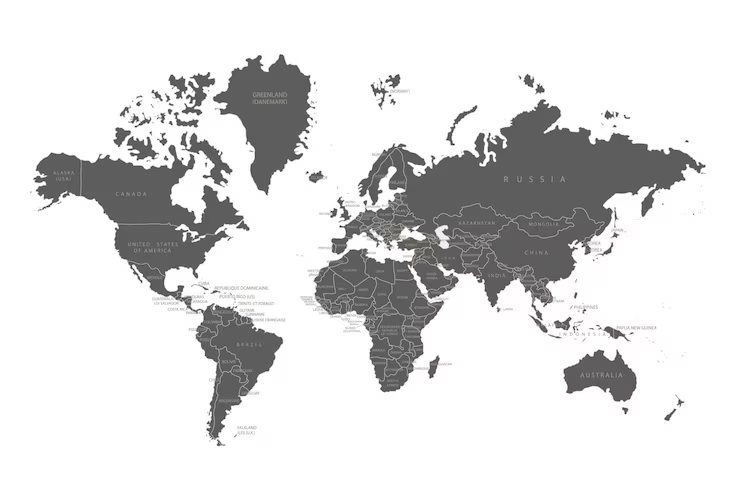
A music supervisor may connect deeply with a song’s message but require a different rhythmic or cultural expression to fit a scene, brand, or region.
Most catalogs force compromise.
Mine doesn’t.
Each composition can be tailored to:
- Geographic markets
- Cultural rhythms
- Cinematic moods
- Brand identities
- Narrative requirements
That flexibility is intentional. It is the result of experience, foresight, and understanding how music functions beyond entertainment.
Music supervisors are not chasing hits.
They are solving problems.
They need:
- Emotional clarity
- Cultural fluency
- Clean rights
- Flexible formats
- Reliable delivery
My catalog is designed for usage, not just consumption.
That is utility.
Exclusivity by Design
This catalog exceeds expectations not just in scale or genre range, but in functionality.
It is:
- Deep, not random
- Intentional, not trend-driven
- Global by design
- Exclusive by choice
None of my new material is currently available on DSPs. That is deliberate. This work is not meant to be diluted by algorithms or buried in noise. It is reserved for serious placements, serious partners, and serious use cases.

Exclusivity preserves value.
The Future Is Utility
The industry continues trying to revive an old model that never truly served creators.
I am not interested in nostalgia.
I am focused on what works now.
Music in the modern era must be adaptable, culturally fluent, structurally strong, and purpose-built. When a single composition can travel across borders, genres, and platforms without losing its identity, that is not a trend.
That is evolution.
And it is a blindspot I have been addressing in plain sight for decades.
Until Next Time…
I Am,
Ewing R. Samuels III