
Enterprise Engineering Series | Communications Practice | Lab 17 of 26
Enterprise engineering extends beyond managing and preserving information. Organizations must also transform business data into accurate, personalized communications that reach customers, employees, partners, and regulatory stakeholders.
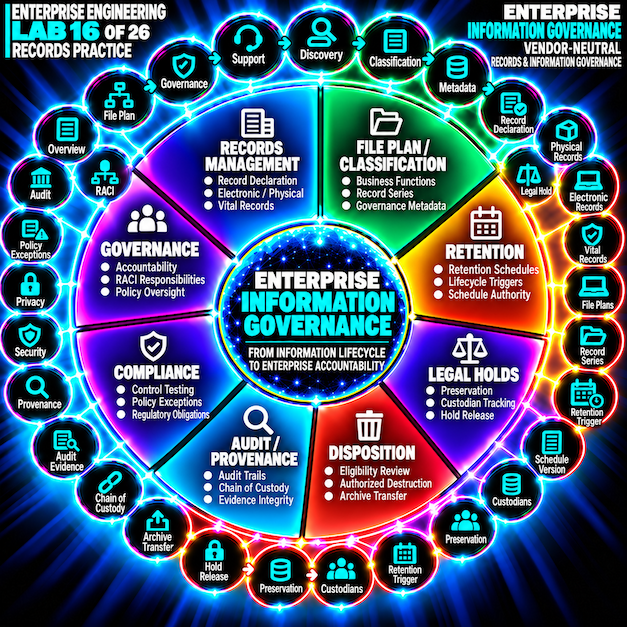
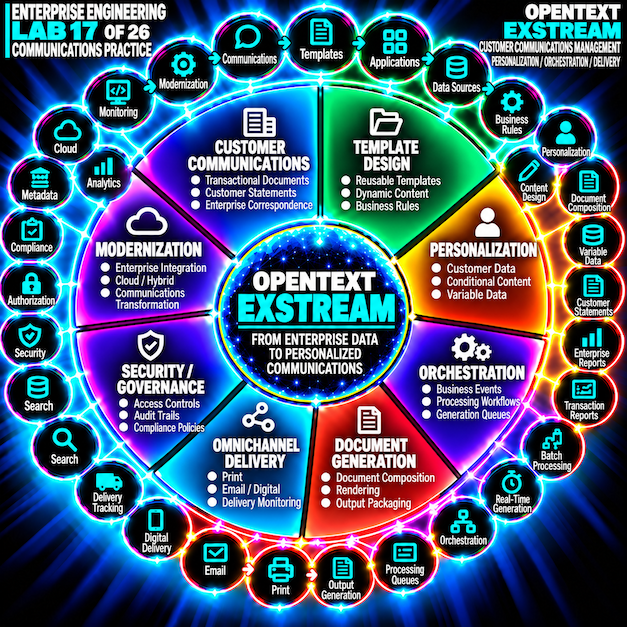
Lab 16 examined enterprise information governance, establishing controls for classification, retention, compliance, and accountability. Lab 17 advances into Customer Communications Management (CCM) through OpenText Exstream, a platform designed to compose, personalize, generate, and deliver enterprise communications.
This Lab examines how communication templates, business rules, enterprise data, and delivery channels can operate within a coordinated architecture.
1. Enterprise Customer Communications Management
Enterprise organizations generate substantial volumes of customer statements, invoices, financial notices, insurance correspondence, transaction reports, and regulatory communications.
Managing these communications individually creates inconsistencies, operational overhead, and compliance risks.
OpenText Exstream addresses these challenges through centralized communication design, reusable content, and automated document composition.
Unlike traditional Enterprise Content Management systems, which primarily organize and manage existing information, Customer Communications Management focuses on transforming business information into communications intended for distribution.
Within the Samuels OpenText Exstream Engineering Lab, the Communication Workspace models customer statements, enterprise reports, transaction reports, generated communications, and compliance records.
These simulated workloads demonstrate how organizations can organize communication operations across multiple business functions.
Engineering Principle: Enterprise communications require a consistent architecture for transforming business information into accurate, customer-facing output.
2. Communication Design and Personalization
Effective enterprise communications begin with reusable templates, structured data, and controlled business rules.
Instead of developing separate communication logic within every business application, organizations can establish common templates that dynamically incorporate customer information, transaction details, conditional content, and regulatory language.
For example, a financial institution may generate thousands of statements using a common design while personalizing customer names, account balances, payment information, and required disclosures.
OpenText Exstream supports personalized document composition, helping organizations maintain consistent branding and communication standards.
The Lab’s Communication / Template Design environment explores application definitions, data sources, metadata, security configurations, and document indexing.
Its illustrative AP_INVOICES application uses fields including INVOICE_NUMBER, VENDOR_ID, INVOICE_DATE, AMOUNT, and STATUS.
These fields represent the demonstration’s document application schema rather than a required native Exstream configuration. They illustrate how structured business information can support downstream processing and retrieval.
Engineering Principle: Reusable templates and controlled business rules enable consistent, personalized communications without duplicating application logic.
3. Orchestration, Generation and Delivery
Communication management requires more than designing documents. Enterprise systems must coordinate when communications are generated, what information they contain, and how they reach their intended recipients.
This involves business events, data validation, processing queues, document rendering, output generation, and delivery monitoring.
OpenText Exstream supports enterprise communication composition and distribution across print and digital channels, including batch and transaction-driven communication scenarios.
The Samuels Engineering Lab models a communication-processing workflow involving document capture, index validation, management review, and communication commitment.
An illustrative workflow, WF-2026-00881, demonstrates how a Finance Operations transaction can progress through controlled processing stages.
In an integrated CCM architecture, an approved business transaction may trigger the generation of an invoice, statement, or customer notification.
The Lab also models generation queues, rendering services, processing analytics, and service monitoring. Its displayed processing figures and workflow events are simulated engineering examples, not production measurements.
Engineering Principle: Communication generation must connect business events, composition rules, and delivery channels through controlled, traceable processing.
4. Integration, Security and Governance
Customer communications frequently contain sensitive financial, personal, and operational information. Their generation and distribution must therefore operate within established enterprise security and governance requirements.
A CCM architecture depends on reliable integration with business applications, databases, identity services, and supporting content repositories.
The Lab illustrates this relationship through configured demonstration data sources, including EXSTREAM_CONTENT_DB, EXSTREAM_RULES_DB, and EXSTREAM_OUTPUT_STORE.
Its security model explores user groups, access privileges, document-level authorization, and directory integration concepts.
Governance examples include seven-year financial record retention, permanent personnel records, and legal preservation holds.
These controls demonstrate how communication output can be managed through integrated governance and records-management services. They should not be interpreted as evidence that Exstream independently provides every archival or legal-hold capability.
This creates a direct connection with Lab 16: information governance establishes organizational requirements, while communication engineering must respect those requirements throughout composition, distribution, and subsequent management.
Engineering Principle: Enterprise communications must maintain security, traceability, and governance across interconnected business systems.
5. Communications Modernization and Operations
Enterprise communications continue to evolve as organizations replace isolated document-generation processes with coordinated digital communication architectures.
Modernization involves consolidating templates, integrating business applications, improving operational visibility, and supporting multiple delivery channels without unnecessarily duplicating communication logic.
OpenText Exstream, currently positioned within the OpenText Communications (Exstream) product lineage, represents an enterprise approach to personalized customer communications.
The Samuels Engineering Lab explores modernization through its Exstream Modernization, Application Integration, Service Monitor, Communication Search, and Output Storage environments.
It also models supporting operational services for rendering, indexing, storage, and application administration.
These components illustrate broader enterprise architecture considerations rather than a mandatory deployment configuration for every OpenText Exstream implementation.
The engineering objective is to establish maintainable communication systems that can adapt to changing business requirements, infrastructure, and customer expectations.
Engineering Principle: Modern customer communications require scalable, maintainable, and channel-independent engineering architectures.
From Principle to Practice — Explore Lab 17
The concepts discussed here can be explored through the corresponding Samuels Enterprises Enterprise Engineering Lab.
LAB 17 — OPENTEXT EXSTREAM
[ LAB 17 INTERACTIVE EXPERIENCE ]

The independent Samuels OpenText Exstream Engineering Lab demonstrates communication administration, template configuration, data integration, processing workflows, security, retrieval, output management, service monitoring, and modernization concepts.
The environment is an educational engineering demonstration, not an official OpenText interface or licensed production installation. Its records, metrics, and operational states are illustrative.
Engineering Conclusion
Enterprise Customer Communications Management is not simply the production of documents. It is the coordinated engineering of business information, reusable communication assets, personalization rules, operational workflows, security controls, and delivery mechanisms.
OpenText Exstream illustrates how these disciplines can support consistent and scalable customer communications.
Successful implementations must preserve information accuracy, communication consistency, security, and traceability while adapting to different business requirements and delivery channels.
Business systems generate information. Enterprise governance establishes control. Customer Communications Management transforms that information into personalized, actionable communications.
The communication must remain accurate, secure, consistent, and governed from composition through delivery.
Lab 17 establishes the foundation for the Communications Practice. Lab 18 will continue this discipline through the next verified platform in the Enterprise Engineering series.