
Enterprise Engineering Series | Records Practice | Lab 16 of 26 Vendor-Neutral Enterprise Records & Information Governance By Ewing R. Samuels III | Samuels Enterprises, LLC
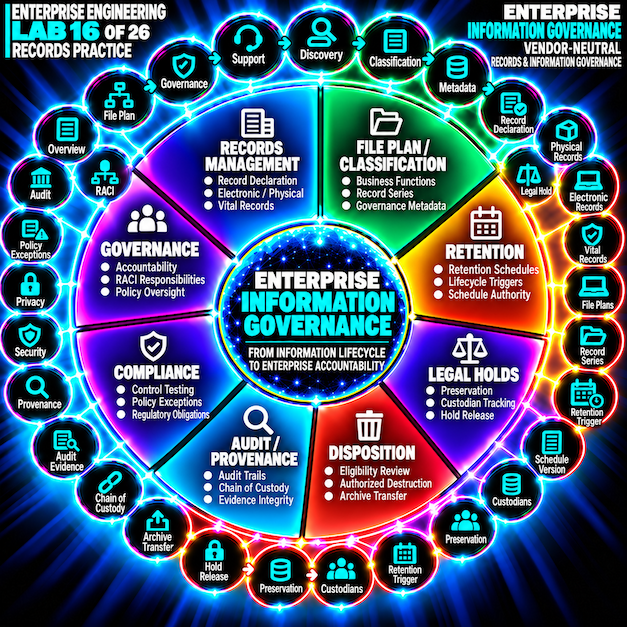
Enterprise information governance establishes how organizations classify, protect, retain, preserve and dispose of information throughout its lifecycle. It extends beyond individual applications to establish consistent policies and accountability across departments, repositories, business systems and physical records environments.
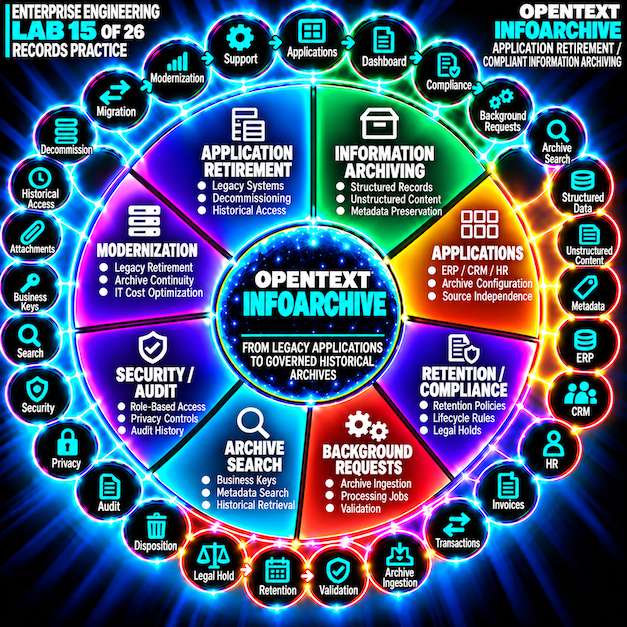
In Lab 15, we examined how OpenText InfoArchive supports the preservation of historical information when legacy applications are retired. Lab 16 advances that engineering discussion from application-specific archiving to enterprise-wide information governance.
The central challenge is no longer simply where information is stored, but how organizations maintain consistent control, legal accountability and verifiable evidence regardless of the technology managing that information.
1. Enterprise Information Governance
Enterprise information governance is the coordinated application of policies, processes, technical controls and organizational responsibilities to information assets.
Modern enterprises operate across content management platforms, financial systems, human resources applications, databases, cloud repositories and physical records facilities. Without a common governance architecture, each environment may apply different classification rules, security requirements, retention periods and disposition procedures.
Effective governance establishes common standards while recognizing the different legal, operational and security requirements of each information category.
The Lab 16 Governance Control Center illustrates this operating model through a governed records inventory, legal holds, pending dispositions, permanent records, policy exceptions, schedule coverage and governance work queues.
These simulated indicators demonstrate how organizations can evaluate governance health and identify records requiring attention.
The engineering objective is to establish governance as an enterprise operating model rather than an isolated software capability.
Engineering Principle: Information governance is an organizational responsibility supported by technology.
2. Records, File Plans and Classification
Consistent records management begins with identifying information, establishing its business purpose and assigning the metadata necessary to govern its lifecycle.
An enterprise file plan organizes records according to business functions, record series and classification rules. These classifications connect information to security requirements, retention schedules, legal obligations and authorized disposition procedures.
Lab 16 demonstrates several illustrative record classifications, including Board Minutes (GOV-BRD-01), Personnel Separation Files (HR-PER-02), General Ledger (FIN-GL-01), Accounts Payable (FIN-AP-02) and Contracts & Agreements (LEG-CTR-01).
One example, record R-100311, represents a Personnel Separation File classified under HR-PER-02. The record combines electronic and physical information, carries confidential access restrictions and references retention schedule HR-2026 v4.2.
Its retention trigger is employee separation, while an active legal hold suspends disposition.
This example demonstrates why classification must represent more than a document label. It must connect the record to enforceable business rules, preservation requirements and governance decisions.
The same principles apply to electronic repositories, physical containers and hybrid records.
Engineering Principle: Consistent classification enables consistent information control.
3. Retention, Legal Holds and Disposition
Records retention defines how long information must be preserved and which events determine when its retention period begins.
A defensible retention schedule identifies the record category, applicable authority, retention trigger, required duration, schedule version and final disposition action.
Lab 16 includes a Retention Schedule Builder that models these relationships and demonstrates how retention rules can be documented and reviewed.
Retention requirements may be based on fixed durations, business events or permanent preservation obligations.
However, expiration of a retention period does not automatically authorize deletion.
Legal holds, investigations, regulatory requirements and unresolved policy exceptions may require continued preservation.
The Lab illustrates this relationship through legal matter MAT-2026-011, a contract dispute, alongside disposition batches covering General Ledger, Board Minutes and Personnel Records.
Before disposition, organizations must establish eligibility, verify that no applicable hold prevents the action, obtain required approvals and document the outcome.
Authorized destruction and permanent archive transfer are distinct disposition actions, each requiring appropriate evidence.
The demonstration models these workflows without executing destruction against live enterprise repositories.
Engineering Principle: Records disposition must be authorized, traceable and defensible.
4. Audit, Provenance and Compliance
Information governance must provide evidence that records have been managed according to established policies and authorized procedures.
Audit trails document activities such as record creation, classification changes, access events, retention assignments, legal holds and disposition approvals.
Information provenance extends this visibility by identifying where information originated, how it entered the governance environment and which transformations or controls were applied.
Lab 16 demonstrates a provenance timeline for record R-100311, originating from an HRIS source record identified as HR-778281.
The illustrated evidence includes capture connector ING-HR-02, classification HR-PER-02, retention schedule HR-2026 v4.2, legal hold MAT-2026-011 and a verified SHA-256 checksum.
These elements establish a model for tracking information integrity, custody and governance history.
The Lab also examines compliance testing, policy authority registers, conflicting retention rules, missing classifications and overdue governance reviews.
Technical logs alone are insufficient when they lack business context, decision authority or evidence of policy compliance.
An effective governance architecture must connect technical events with organizational responsibilities and documented decisions.
Engineering Principle: Governance decisions must be supported by verifiable evidence.
5. Governance Accountability and Operations
Technology can enforce controls, but it cannot independently establish the organizational authority required to approve every governance decision.
Enterprise information governance therefore requires coordinated participation from Records, Legal, Compliance, Business, Security and Archives functions.
Lab 16 illustrates these responsibilities through a RACI governance model:
- Responsible: Performs the governance activity.
- Accountable: Owns the decision and its outcome.
- Consulted: Provides required expertise or authorization input.
- Informed: Receives relevant decisions and status information.
This structure helps distinguish technical execution from organizational accountability.
The Lab also models recurring governance activities, including quarterly retention schedule reviews, monthly legal hold reviews, disposition approval cycles, annual policy attestations and exception remediation.
For example, an enterprise records system may enforce a seven-year retention requirement. However, authorized business, legal and records personnel must determine whether that schedule remains appropriate and legally defensible.
Governance must therefore evolve alongside regulatory obligations, organizational changes and enterprise architecture.
Engineering Principle: Effective information governance requires defined authority, accountability and continuous oversight.
From Principle to Practice — Explore Lab 16
The concepts discussed here can be explored through the corresponding Samuels Enterprises Enterprise Engineering Lab.
LAB 16 — ENTERPRISE INFORMATION GOVERNANCE
[ LAB 16 INTERACTIVE EXPERIENCE ]

The independent, vendor-neutral demonstration explores records declaration, file plans, classification, discovery, retention schedules, legal holds, disposition, audit trails, provenance, compliance exceptions and governance accountability.
All records, numerical indicators and workflow actions are illustrative demonstration data, not live enterprise production operations.
Engineering Conclusion
Enterprise information governance cannot be achieved simply by purchasing records management software.
Organizations must establish consistent classification standards, approved retention policies, legal preservation procedures, defensible disposition processes, verifiable audit evidence and clearly assigned responsibilities.
Applications will change. Information repositories will evolve. Business and regulatory obligations will continue.
The purpose of enterprise information governance is to maintain consistent control and accountability throughout those changes.
The ultimate engineering objective is not merely to preserve information, but to preserve its integrity, context, accountability and evidentiary value throughout its lifecycle.
Lab 16 concludes the Records Practice within the 26-Lab Enterprise Engineering Series, establishing a foundation for the next engineering discipline.