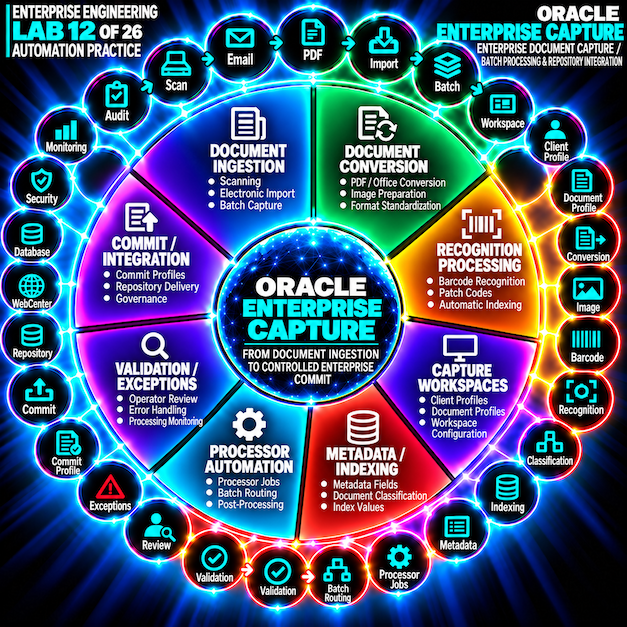

Enterprise Engineering Series | Automation Practice | Lab 12 of 26 Oracle WebCenter Enterprise Capture By Ewing R. Samuels III | Samuels Enterprises, LLC
Enterprise automation requires more than converting paper into digital documents. Organizations must control how information enters their systems, how it is processed, how metadata is assigned, and how documents reach their intended destinations.
In Lab 11, we examined how OpenText Capture and EMC Captiva support intelligent document processing, verification, and controlled delivery. Lab 12 continues this engineering progression through Oracle WebCenter Enterprise Capture, focusing on configurable capture workspaces, batch processing, processor automation, and enterprise repository integration.
Unlike Oracle WebCenter Content, which primarily addresses enterprise content management and repository services, Oracle Enterprise Capture concentrates on preparing and delivering information into those environments.
1. Enterprise Document Capture and Batch Ingestion
Oracle WebCenter Enterprise Capture provides a configurable environment for acquiring documents from scanning operations and electronic sources.
Its capture architecture supports distributed document intake through capture clients, configured workspaces, and automated import processes.
Documents are organized into batches, allowing administrators and operators to manage groups of related information throughout the processing lifecycle.
Key architectural components include the Capture Client, Import Processor, client profiles, document profiles, and batch tracking.
A financial institution, for example, may receive loan applications from branch scanners, electronic submissions, and other configured intake channels. Capture profiles help standardize how these documents enter the processing environment.
Engineering Principle: Controlled document ingestion establishes the foundation for reliable enterprise processing.
2. Document Conversion and Recognition
Enterprise documents arrive in different formats and conditions. Before information can be classified or indexed, documents may require conversion and preparation.
Oracle Enterprise Capture uses the Document Conversion Processor to transform supported electronic documents into configured output formats suitable for subsequent processing.
The Recognition Processor performs a different responsibility. It can identify configured recognition elements, including barcodes and patch codes where supported, and use recognition results to assist with document separation and automatic indexing.
These processors can operate as distinct stages within a configured batch workflow.
Conversion standardizes document representation. Recognition interprets configured document characteristics and helps determine subsequent processing actions.
Separating these responsibilities allows organizations to adjust document preparation without redesigning their entire capture architecture.
Engineering Principle: Standardized document preparation improves recognition accuracy and processing consistency.
3. Capture Workspaces, Profiles and Metadata
Capture workspaces provide the administrative structure for defining how different document categories are processed.
Within a workspace, administrators configure client profiles, document profiles, metadata fields, processing rules, and related processor jobs.
A healthcare organization, for example, may require different metadata for patient registration forms, insurance documents, and administrative correspondence.
Each category may have distinct indexing requirements and repository destinations.
Metadata fields transform documents from isolated digital files into organized business information. Proper indexing enables downstream repositories to support searching, retrieval, retention, and information governance.
This connects directly to the information architecture principles explored throughout the earlier Enterprise Content Management Labs.
Engineering Principle: Document capture becomes enterprise information processing when content is correctly classified and indexed.
4. Processor Automation and Exception Control
One of Oracle Enterprise Capture’s defining architectural characteristics is its configurable processor-driven workflow.
Four important components coordinate document processing:
- Import Processor: Acquires documents from configured sources and creates batches.
- Document Conversion Processor: Converts supported documents into configured formats.
- Recognition Processor: Performs configured recognition, separation, and indexing operations.
- Commit Processor: Delivers processed documents and metadata to configured destinations.
Processing jobs and post-processing configurations determine how batches advance between stages.
However, successful completion of one processor does not guarantee successful completion of the entire workflow.
Documents may require operator corrections, indexing verification, or exception handling before proceeding.
Administrators must therefore distinguish between processor execution, batch status, and final delivery.
Engineering Principle: Enterprise automation must coordinate processing stages without losing control of exceptions.
5. Commit Processing and Enterprise Integration
The Commit Processor represents the critical transition from document preparation to enterprise information delivery.
Commit profiles define how processed documents and associated metadata are transferred to configured destinations, including supported integrations with Oracle WebCenter Content.
These configurations can specify output formats, metadata mappings, and destination requirements.
Releasing a batch for another processing stage is not equivalent to successfully committing its documents.
A completed commit requires the intended documents and metadata to reach their configured destination successfully.
Failed transfers, invalid metadata, unavailable repositories, or configuration problems must be addressed through appropriate exception handling and monitoring.
Security, traceability, and operational verification remain essential throughout this process.
Engineering Principle: Capture processing is complete only when documents and metadata are successfully committed.
From Principle to Practice — Explore Lab 12
The concepts discussed here can be explored through the corresponding Samuels Enterprises Enterprise Engineering Lab.
LAB 12 — ORACLE ENTERPRISE CAPTURE
[ LAB 12 INTERACTIVE EXPERIENCE ]

The article explains the engineering principle. The Lab demonstrates how that principle appears inside a configurable enterprise document capture and batch processing environment.
This is a Samuels Enterprises engineering demonstration workspace, not an official Oracle product interface.
Engineering Conclusion
Oracle WebCenter Enterprise Capture demonstrates how enterprise document automation depends on the coordination of multiple processing stages.
Capture workspaces, document conversion, recognition, metadata indexing, processor jobs, and commit profiles collectively establish a controlled path from document acquisition to enterprise information delivery.
Modern intelligent document processing technologies may extend these capabilities, but the underlying engineering requirements remain consistent: accuracy, configuration control, exception management, and reliable integration.
The objective is not simply to digitize documents. It is to ensure that information becomes usable, governed, and accessible within enterprise systems.
Final Engineering Principle: Enterprise document capture must transform incoming documents into accurately indexed, verified, and successfully committed business information.
As the Automation Practice continues into Lab 13, the focus advances from configurable capture and repository delivery toward the next enterprise automation challenge in the established 26-Lab sequence.