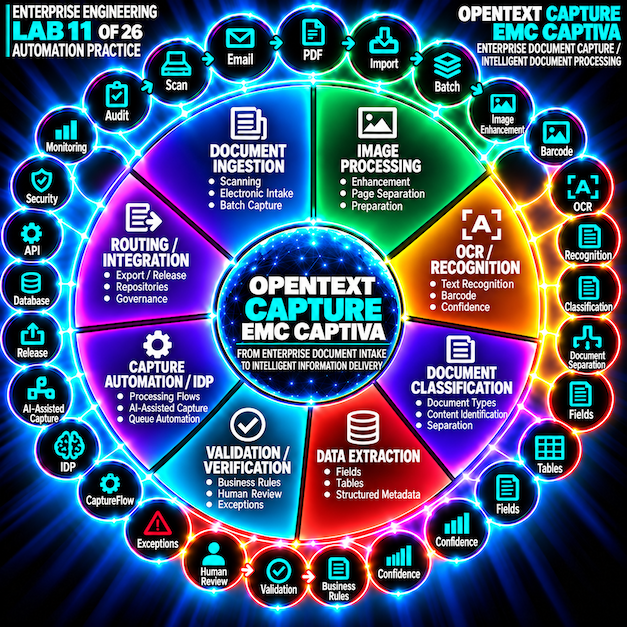

Enterprise Engineering Series | Automation Practice | Lab 11 of 26 OpenText Capture / EMC Captiva By Ewing R. Samuels III | Samuels Enterprises, LLC
Enterprise automation begins with a fundamental challenge: converting documents into accurate, usable business information.
In Lab 10, we examined how IBM Datacap supports document acquisition, recognition, classification, extraction and validation. Lab 11 continues this exploration through OpenText Capture and the EMC Captiva product lineage, examining how traditional enterprise capture architectures have evolved toward intelligent document processing (IDP).
The engineering objective extends beyond scanning documents. It involves controlling how information enters an organization, how its contents are interpreted, how exceptions are resolved and how verified information reaches enterprise systems.
1. Enterprise Scanning and Document Ingestion
Enterprise capture begins with the controlled acquisition of information from multiple sources.
EMC Captiva established an enterprise capture architecture supporting high-volume scanning, distributed capture, electronic document ingestion and batch-oriented processing.
Modern capture environments extend these principles across PDFs, email attachments, electronic documents and other business inputs.
A typical intake architecture includes:
- Document acquisition: Scanning, file imports and electronic intake.
- Image processing: Enhancement, orientation correction and document preparation.
- Batch management: Grouping, separation and processing status.
- Intake control: Tracking documents from acquisition through processing.
These capabilities create a consistent entry point for information that may arrive in different formats and from different locations.
Engineering principle: Document intake must be controlled before automation can be trusted.
2. Recognition and Document Classification
Once documents enter the capture environment, the system must determine what they contain and how they should be processed.
Traditional capture architectures frequently relied on templates, recognition rules, OCR and barcode identification. These approaches remain useful when document layouts are predictable.
However, enterprise documents are not always consistent.
Invoices, contracts, correspondence and application forms may vary in structure even when they serve the same business purpose.
Document classification provides the foundation for directing each document into the appropriate extraction and validation workflow.
Modern approaches can combine recognition rules with content-aware classification to accommodate greater document variation.
Engineering principle: Accurate classification enables the correct processing rules to be applied before business information is extracted.
3. Data Extraction and Intelligent Document Processing
Recognition identifies document content. Extraction converts relevant content into structured business data.
Capture architectures may extract invoice numbers, customer identifiers, transaction dates, monetary amounts, line items and other required fields.
Traditional fixed-layout extraction uses predefined locations or patterns. More adaptive approaches examine document content and context to identify information across varying layouts.
Modern OpenText capture capabilities can incorporate AI-assisted recognition and intelligent document processing, depending on the product and deployment.
The historical EMC Captiva platform and today’s OpenText Capture offerings should therefore be understood as related stages in enterprise capture evolution, rather than identical implementations.
Confidence scores and extraction rules help determine which results are sufficiently reliable for automated processing and which require further verification.
Engineering principle: Intelligent capture must interpret document content without sacrificing verifiability.
4. Validation, Human Review and Capture Automation
Extracted information is not automatically reliable simply because a system recognized it.
Enterprise capture workflows require validation rules, required-field checks, exception handling and human verification.
For example, an invoice-processing workflow may verify that required identifiers exist, monetary fields follow expected formats and extracted values satisfy configured business rules.
Documents meeting those requirements may continue automatically. Uncertain or incomplete results can enter verification queues for operator review.
CaptureFlow-style processing pipelines illustrate how acquisition, recognition, extraction, verification and release can be coordinated through configured stages.
This approach reduces repetitive handling while preserving accountability for exceptions and corrections.
Engineering principle: Automation should reduce repetitive work without removing accountability.
5. Routing, Release and Enterprise Governance
Document processing does not end when extraction succeeds.
Verified documents and metadata must reach their intended enterprise destinations.
Depending on configuration and available integration capabilities, capture systems can release information to content repositories, databases, ERP platforms, CRM applications and other business environments.
This connects Lab 11 with the enterprise content management architectures examined in Labs 01–08, including the OpenText ECM environment introduced in Lab 02.
A conceptual information pipeline follows:
Document Intake → Recognition → Classification → Extraction → Validation → Human Verification → Routing → Enterprise Repository
Enterprise integration requires destination rules, security controls, processing queues, monitoring and audit records.
An important distinction exists between successfully processing a document and successfully delivering it. Failed exports, rejected transactions and unavailable destinations must remain visible and recoverable.
Engineering principle: Capture is not complete until verified information reaches its intended destination.
From Principle to Practice — Explore Lab 11
The concepts discussed here can be explored through the corresponding Samuels Enterprises Enterprise Engineering Lab.
LAB 11 — OPENTEXT CAPTURE / EMC CAPTIVA
LAB 11 INTERACTIVE EXPERIENCE

The article explains the engineering principle. The Lab demonstrates how that principle appears inside an enterprise capture and intelligent document processing environment.
This is a Samuels Enterprises engineering demonstration workspace, not an official OpenText product interface.
Engineering Conclusion
The evolution from EMC Captiva to modern OpenText capture technologies demonstrates an important architectural progression.
Enterprise capture is no longer limited to scanning documents and recognizing text. It increasingly combines classification, data extraction, intelligent processing, human verification and governed information delivery.
The value of this architecture lies not simply in processing documents faster, but in producing reliable information that enterprise systems can use with confidence.
Final engineering principle: Intelligent document capture must deliver verified business information through controlled, traceable enterprise processes.
As the Enterprise Engineering series continues into Lab 12, the next challenge is to examine how the subsequent automation platform addresses information processing, workflow coordination and enterprise integration within its own architecture.