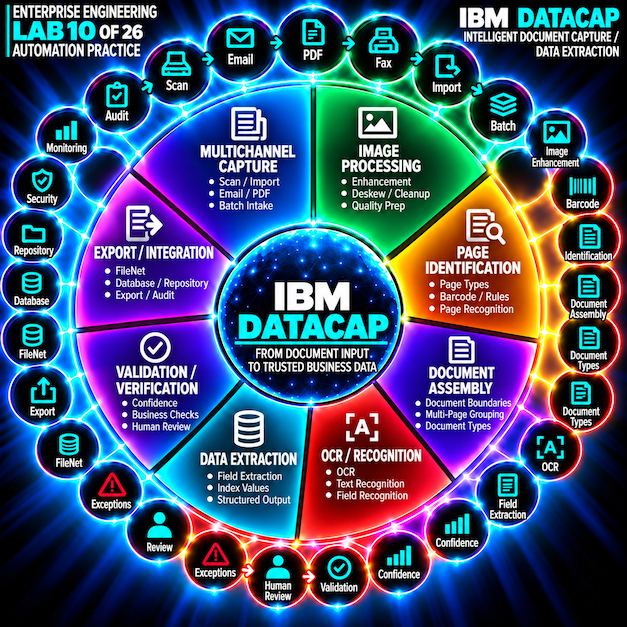

Enterprise Engineering Series | Automation Practice | Lab 10 of 26 IBM Datacap By Ewing R. Samuels III | Samuels Enterprises, LLC
Enterprise automation depends on more than processing documents. Information must be accurately captured, recognized, structured, validated and delivered to business systems.
In Lab 09, we examined how Kofax / Tungsten TotalAgility supports intelligent process automation through document processing, business rules and orchestration.
Lab 10 shifts the engineering focus to IBM Datacap, exploring how enterprises transform incoming documents into reliable, structured business information.
The central question is: How can organizations process large volumes of documents while maintaining accuracy, reliability and control?
1. Document Acquisition and Multichannel Capture
Enterprise documents arrive through scanners, PDFs, email, fax, digital forms and imported batches.
IBM Datacap provides a framework for capturing and preparing these inputs for automated processing.
Engineering challenges include inconsistent formats, incomplete submissions, poor image quality and batch separation. Each can compromise downstream recognition and extraction.
Engineering principle: Capture quality determines downstream reliability.
Reliable automation begins with controlled document acquisition, not simply receiving files.
2. Image Processing and Document Identification
Before extracting information, documents must be prepared and correctly identified.
Datacap supports image enhancement, page identification and document assembly. Processing can address skewed images, unwanted noise, inconsistent orientation and document boundaries.
A ten-page submission may contain several independent documents. Identifying individual pages and assembling them correctly prevents unrelated information from being processed together.
The objective is to maintain accurate document structure throughout the capture pipeline.
3. OCR, Classification and Data Extraction
IBM Datacap uses recognition and extraction capabilities to convert document content into structured business information.
Consider three common enterprise scenarios:
- Invoices: Vendor, invoice number, date and amount.
- Applications: Applicant information and reference numbers.
- Business forms: Required fields, index values and metadata.
OCR recognizes characters, while extraction workflows identify information required by downstream systems.
Confidence assessments help distinguish reliable results from information requiring further examination.
Engineering principle: Extracting text does not automatically establish information accuracy.
4. Validation, Verification and Exception Handling
Automated recognition must be supported by validation.
Datacap workflows can check required fields, acceptable formats, business rules and recognition confidence.
When information fails validation, it can be directed to human verification and correction.
Unreadable pages, missing information and extraction failures must become visible exceptions rather than silently entering enterprise systems.
Engineering principle: Recognition alone does not establish accuracy.
Effective automation combines machine processing with controlled human intervention.
5. Enterprise Integration and Governance
Verified documents and extracted metadata become valuable when delivered to enterprise repositories, databases and business applications.
This connects directly to Lab 03 — ECM – IBM FileNet.
A supported integration architecture follows:
IBM DATACAP → CAPTURE AND VERIFY → STRUCTURED DOCUMENTS AND METADATA → IBM FILENET → ENTERPRISE CONTENT MANAGEMENT
In this architecture, Datacap handles capture and verification while FileNet manages enterprise content. This is one supported integration pattern, not a mandatory configuration.
Security, monitoring, traceability, exception handling and audit records help ensure information remains governed throughout processing.
The engineering objective is a reliable information pipeline connecting original documents to verified business records.
From Principle to Practice — Explore Lab 10
The concepts discussed here can be explored through the corresponding Samuels Enterprises Enterprise Engineering Lab.
LAB 10 — IBM DATACAP
[ LAB 10 INTERACTIVE EXPERIENCE ]

EXPLORE LAB 10 →
The article explains the engineering principle.
The Lab demonstrates how that principle appears inside an enterprise document capture and data extraction platform.
Engineering Conclusion
IBM Datacap demonstrates how document capture becomes a governed enterprise information process.
Acquisition, identification, recognition, extraction and verification must operate together to produce dependable business data.
Modern intelligent document processing extends these capabilities through advanced recognition, automated classification and integration with enterprise workflows. However, governance and verification remain essential regardless of the underlying technology.
Enterprise capture must transform documents into trustworthy, structured and actionable business information.
Continuing the Automation Practice
Lab 10 establishes how documents become verified enterprise information.
But another engineering challenge remains: How does the enterprise coordinate that information across business rules, approvals, applications and automated workflows while maintaining accountability?
This question carries the Enterprise Engineering series forward into Lab 11 and the next stage of the Automation Practice.