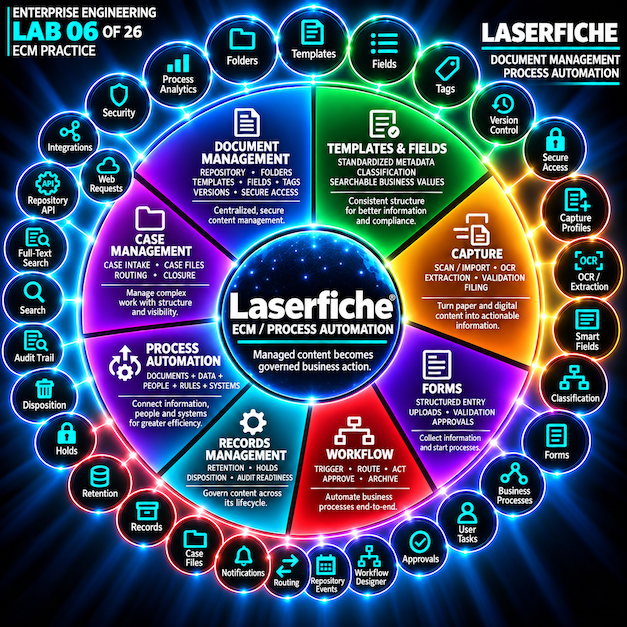

Enterprise Engineering Series | ECM Practice | Lab 06 of 26
Laserfiche
By Ewing R. Samuels III | Samuels Enterprises, LLC
An enterprise can manage documents perfectly and still force people to manage the work surrounding those documents manually.
A form arrives. Someone reads it. Someone enters metadata. Someone routes it. Someone waits for approval. Another system must be updated. Eventually, someone files the result.
The document may be controlled.
The process surrounding it may still be fragmented.
That distinction is where Laserfiche becomes important in the Enterprise Engineering progression.
Lab 05 examined Alfresco through structured, extensible and interoperable content architecture. Laserfiche pushes the next question:
Can the work surrounding governed information become controlled, repeatable and automated?
That moves ECM from managed content toward content-driven process automation.
When Content Becomes Operational
The repository still matters.
Documents must be stored securely. Metadata must be reliable. Access must be controlled. Versions, classifications and retention requirements still matter.
But enterprise content becomes more valuable when information can participate directly in business work.
A useful architectural progression is:
CAPTURE → CLASSIFY → STORE → TRIGGER → ROUTE → ACT → APPROVE → GOVERN → AUDIT
At that point, ECM does more than answer:
Where is the document?
It begins helping the enterprise answer:
Who needs to act?
What can the system do automatically?
Where is human judgment required?
What other systems must participate?
What evidence remains afterward?
Structured Information Before Automation
Automation depends on context.
A workflow cannot reliably make decisions from a filename alone. Systems need machine-readable information describing what something is, what values it contains and what rules apply.
Laserfiche Templates and Fields illustrate this well.
Metadata may represent customer, department, date, amount, case number, document type or status.
That creates a progression:
DOCUMENT → TEMPLATE → FIELD → CLASSIFICATION → SECURITY → PROCESS
Metadata therefore does more than describe content.
Metadata can drive process.
Once information has structure, the system can evaluate, route, search and govern it.
Automation is only as reliable as the information entering it.
Capture Becomes Part of the Process
Laserfiche demonstrates that automation can begin before a document reaches its final repository location.
Capture can include scanning or importing content, OCR, data extraction, template selection, classification, validation and routing.
The sequence becomes:
IMPORT / SCAN → OCR → EXTRACT → CLASSIFY → VALIDATE → FILE → TRIGGER
Capture is therefore no longer simply about digitizing paper.
It becomes the first stage of process execution.
The better the system understands incoming information, the more intelligently the enterprise can respond to it.
Forms as Process Entry Points
Not all enterprise information begins as a document.
Sometimes it begins with structured information entered directly by a user.
Digital forms can provide controlled fields, calculations, validation, uploads and approvals before a traditional document even exists.
That produces:
FORM → DATA → DOCUMENT → TASK → PROCESS
A form can therefore become the beginning of a governed business process rather than merely an electronic replacement for paper.
Workflow: From Event to Action
Workflow is where the architecture becomes operational.
The Laserfiche Lab models a useful sequence:
TRIGGER → ROUTE → ACT → APPROVE → ARCHIVE
A trigger may come from a repository event, form submission, schedule or process event.
Routing evaluates conditions.
Actions may update metadata, manage repository content, send notifications or interact with another system.
Approval introduces human judgment where necessary.
Archiving completes the cycle by filing, classifying and preserving the result.
This is more than moving documents between employees.
A process can contain both:
HUMAN TASKS
and
SYSTEM TASKS
Good automation does not remove people from everything.
It determines what systems should perform automatically and where human review, authorization or judgment remains necessary.
SYSTEM AUTOMATION + HUMAN DECISION = GOVERNED PROCESS
Documents + Data + People + Rules + Systems
This is the architectural center of Lab 06.
A business process may contain documents, structured data, employees, business rules, approvals, notifications, records obligations and interactions with external systems.
A stronger model is:
DOCUMENTS + DATA + PEOPLE + RULES + SYSTEMS = BUSINESS PROCESS
This is where ECM begins functioning as operational infrastructure rather than passive storage.
A process may:
receive information
→ validate content
→ classify it
→ call another system
→ update metadata
→ create a task
→ wait for approval
→ preserve the result
At that point, integration is no longer merely connectivity.
It becomes a step inside the business process.
When the Process Is Not Linear
Not every business process follows a straight line.
Some activities revolve around a case, claim, application, customer or investigation.
That case may accumulate documents, metadata, correspondence, decisions, tasks and audit history.
A useful progression is:
CASE INTAKE → CASE FILE → CASE ROUTING → AUTHORIZED ACCESS → CASE CLOSURE
The objective is no longer simply moving an item from Step A to Step B.
It is preserving the complete operational context surrounding a business matter.
Automation Must Remain Governed
Automation does not remove governance requirements.
It increases their importance.
A completed workflow may produce content that becomes an organizational record subject to retention, legal hold, access restrictions or disposition rules.
The process may continue:
PROCESS COMPLETE → CLASSIFY → RETAIN → AUDIT → DISPOSE
The same applies to auditability.
If automated processes route information, change metadata or interact with other systems, the organization must still establish:
What happened?
Who acted?
When?
What changed?
What evidence remains?
The principle is simple:
Automation must produce evidence.
Efficiency cannot come at the expense of accountability.
From Principle to Practice — Explore Lab 06
The concepts discussed here can be explored through the corresponding Samuels Enterprises Enterprise Engineering Lab.
LAB 06 — LASERFICHE
[ LAB 06 INTERACTIVE EXPERIENCE ]

The article explains the engineering principle.
The Lab demonstrates how that principle appears inside an enterprise system.
The Larger Engineering Lesson
Laserfiche extends the ECM progression by pushing beyond the repository.
Documents, metadata, security, records controls, search and auditability still matter.
But the larger question becomes what the enterprise can reliably do once information enters the system.
Can information trigger action?
Can routine work be automated?
Can people be inserted only where judgment is needed?
Can other enterprise systems participate without breaking governance?
Can the complete process be reconstructed afterward?
That is the difference between:
MANAGING CONTENT
and
ORCHESTRATING WORK AROUND CONTENT.
The central engineering question becomes:
How does enterprise information become controlled, repeatable business action?
Laserfiche provides one answer by connecting managed content with capture, forms, workflow, people, systems and governance.
But as more applications and business experiences depend on centrally managed content, another architectural problem appears:
How should the enterprise deliver that information consistently across a broader application environment?
That takes us into Lab 07 — ECM – Oracle WebCenter Content / UCM.