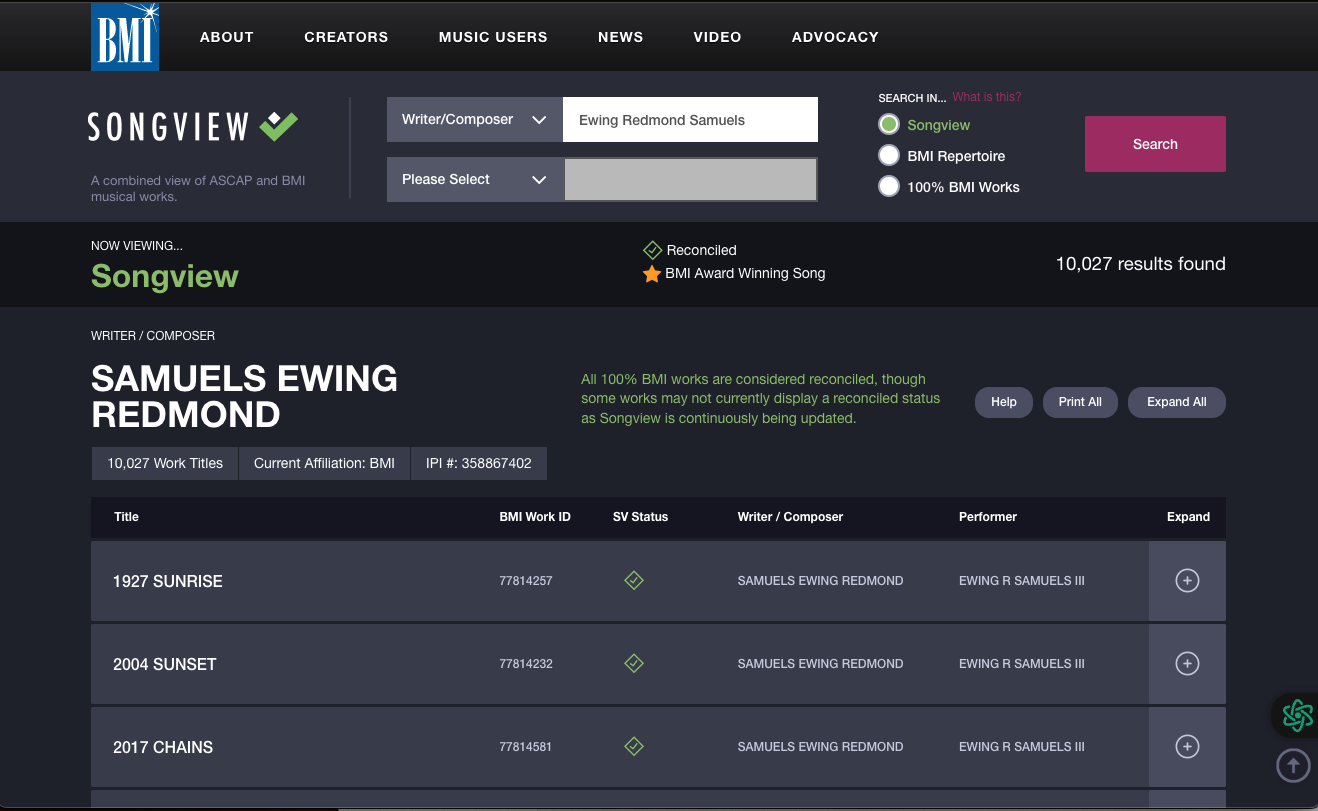

There are moments where numbers speak louder than anything else.
This is one of them.
As of April 2026, I have officially reconciled and registered 10,000 compositions with Broadcast Music, Inc..
Not created overnight.
Not manufactured for headlines.
Not inflated.
Documented.
From 900 to 10,000 — What Actually Happened
On paper, the shift looks dramatic:
- January 2026: ~900 registered works
- March 2026: 10,000+ registered works

That kind of movement invites questions.
The explanation is simple:
This was not a writing sprint.
This was a catalog reconciliation event.
For years, my compositions existed across multiple environments—stored, archived, carried forward through different systems and phases. What changed in 2026 was not the volume of creation, but the formalization of the catalog into a unified, verifiable structure.
Everything aligned.
Everything accounted for.
Everything visible.
30 Years In — Pattern Recognition
I signed with BMI as a teenager.

Songwriter first.
Publisher next.
Three decades later, I’m now being referred to as a “legacy” member.
That simply means I’ve had the vantage point to observe long-term patterns—not surface trends, but structural shifts.
When The Model Changed
While working at Interscope Records in the early 2000s, there was a noticeable adjustment in behavior—less emphasis on physical product, fewer CDs being printed.

At the time, it looked subtle.
In reality, it was foundational.
It signaled a shift toward digital distribution, scale economics, and centralized control over access and exposure.
Those who recognized it early adjusted.
Those who didn’t are still trying to catch up.
The Misalignment Today
There is still a widely held belief that one song can break through on its own.
That model belonged to a different time.
Today, 3 millions of songs enter the ecosystem on a monthly basis. The probability landscape has changed.
This has nothing to do with artistic quality.
I have compositions within this catalog that meet, and in many cases exceed, the standard of records that chart at the highest levels.

Quality alone is not the determining factor.
Outcomes at scale are structured, coordinated, and repeatable processes.
Music and Its Underlying System
Music remains the core product.
But the outcome is determined by the system surrounding it.
Distribution pathways.
Ownership structures.
Rights management.
Catalog organization.
These are the elements that define how value is realized over time.
A Structured Body of Work
My approach reflects that reality.
This catalog is not a collection of isolated songs.

It is a structured body of intellectual property, built with continuity across:
- Composition
- Writing
- Arrangement
- Production
- Publishing
- Catalog organization
Each component is intentional.
Each piece is connected.
Ownership, Control, and Clarity
For clarity:
- All compositions are written by me
- The catalog is 100% owned by me
- The works are now fully registered, organized, and traceable
What was once distributed across systems is now consolidated into a single, coherent framework.
Asset Preservation
A significant portion of this catalog was stored on hard drives that were targeted in 2016.
The material remained intact.
Today, those same works are no longer just stored—they are formally recognized, registered, and protected within an established rights system.
A Measurable Transition
10,000 is not just a number.
It marks a transition:
From stored work → to registered assets
From fragmented files → to structured catalog
From unseen → to verifiable
It represents a body of work that is now positioned within a system designed to track, manage, and account for it over time.
Still Early
This is not a peak.
It is an early stage within a much larger framework that continues to expand—deliberately, consistently, and with structure.
The catalog grows daily.
Not as isolated output.
But as a continuously developing system.

The Reality
Music is the foundation.
But the system around it determines the outcome.
Understanding that distinction changes how the work is created, organized, and positioned.
And once that understanding is applied at scale, the results begin to look different.
Until Next Time…
I Am,
Ewing R. Samuels III